I Slept With My Boss During a Business Trip, and Now I Regret It

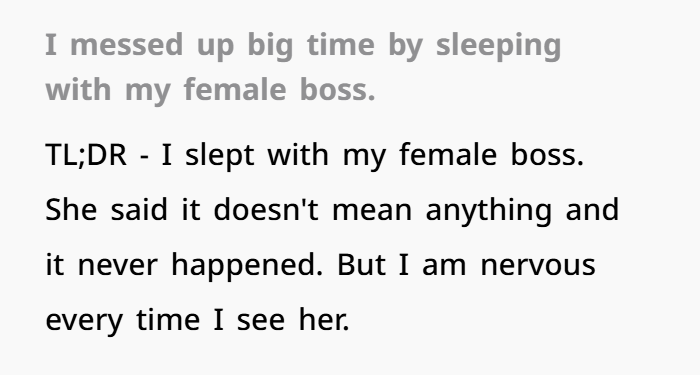
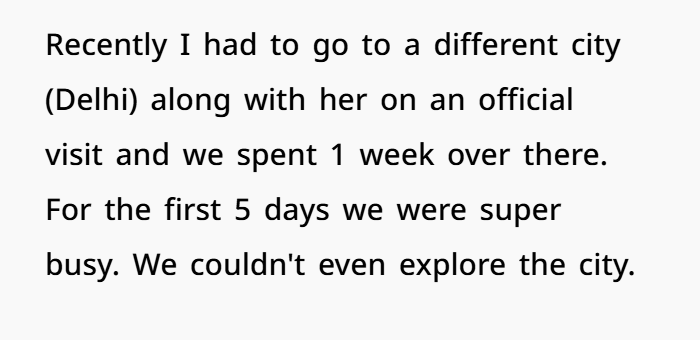
A business trip to Delhi started out completely normal. An employee traveled there with his female boss for work. For several days, they were busy with meetings and other job duties.
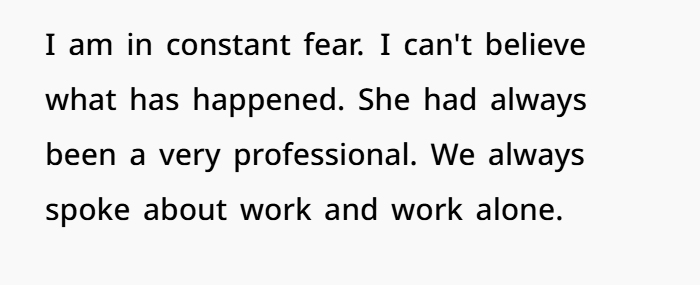
Their relationship had always been professional. They mostly talked about work, and he had never noticed any romantic interest from her.
But things changed during the last two days of the trip.
They were staying in an executive suite and finally had some free time. After dinner one evening, they sat together, watched TV, talked about random things, and joked about people from work.
Later, they went to their separate rooms.
After taking a shower, the employee returned to his room and was surprised to find his boss sitting on his bed. She had dressed up for the evening.
At first, he thought she was joking.
She told him she was serious. They talked about the situation for around half an hour, and she made it clear that he could say no.
The two eventually became intimate. The same thing happened again the next day.
Before they checked out of the hotel, however, his boss told him they should never talk about what happened.
As soon as the business trip ended, she went back to being completely professional.
At work, she behaved as if nothing had changed. There were no personal conversations about the trip and no sign that she wanted to discuss their workplace relationship. For the boss, the situation appeared to be over.
The employee felt very differently. What happened had changed the way he saw their working relationship, leaving him worried about professional boundaries, his career, and possible workplace issues.
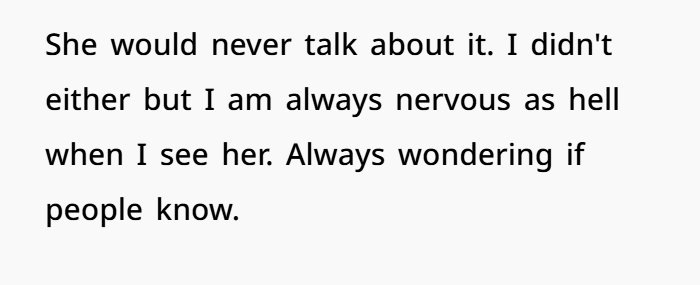
He said seeing his boss now makes him extremely nervous. He keeps wondering if coworkers somehow know what happened and worries about what the situation could mean for his job.






The biggest issue in this story is not simply that two coworkers slept together.
One of them is the other’s boss.
That creates a workplace power imbalance, even when both people appear to agree to the relationship. A manager may have influence over assignments, performance reviews, promotions, pay decisions, schedules, and future career opportunities.
That is one reason workplace relationships between managers and employees can create serious HR and employment issues.
SHRM guidance on workplace relationships explains that some employers require workers to disclose romantic relationships, especially when there could be a conflict of interest. Company rules can be very different, so the employer’s own workplace relationship policy matters.
In this case, the power difference is hard to ignore.
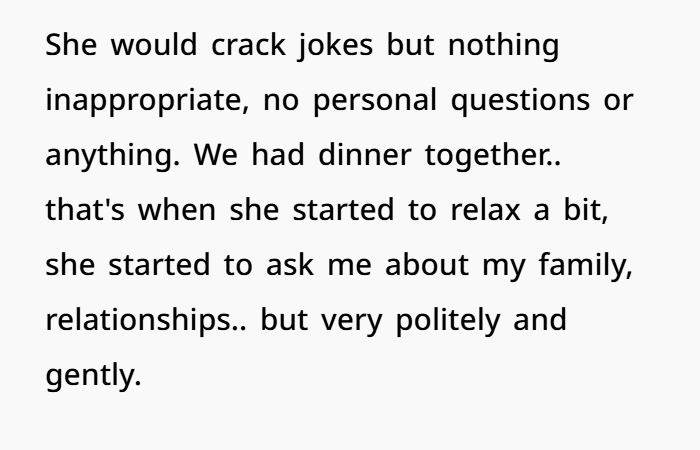
The employee described his boss as highly professional before the Delhi business trip. Their conversations were almost entirely about work. Even while exploring the city together, she kept things professional.
Dinner was where the tone slowly changed.
She began asking about his family and relationships, though he said she remained polite and gave no obvious sign that she wanted something more.
Then came the hotel arrangement.
For the first five days, they stayed in separate rooms at a five-star hotel. For the final two days, they chose an executive suite at another five-star hotel rather than paying for extra accommodation themselves.
That decision put them in much closer personal space.
Research into workplace risks shows why situations like this deserve attention. The UK’s Acas guidance on preventing s*xual harassment lists power imbalances and overnight work travel among factors employers should consider when looking at harassment risks.
Of course, that does not automatically mean this particular encounter was harassment. The original account says the boss told the employee he could refuse, and he ultimately agreed.
Still, consent does not erase the workplace problem created by a boss-subordinate relationship.
SHRM describes relationships between managers and direct reports as particularly risky because of the power difference involved. Problems can appear later, especially if the personal relationship ends badly or starts affecting workplace decisions.
There is another detail that makes the employee uncomfortable.
Before checking out, his boss told him to treat the entire experience as though it never happened. She did not want him bringing it up again.
Then she followed through.
Back at work, she behaved exactly as she had before the trip. No flirting. No private conversations about the hotel. No acknowledgement of what happened between them.
That sudden switch seems to be a major reason the employee feels so anxious.
He does not describe wanting another encounter. Instead, he seems worried about workplace consequences, office gossip, his professional reputation, and the possibility that coworkers might discover what happened.
Those fears are understandable in a manager-employee situation because even a consensual workplace romance can raise questions about favoritism and conflicts of interest.
SHRM notes that workplace relationship policies are often designed to protect against problems involving favoritism, retaliation, and s*xual harassment. When a manager and subordinate are involved, an employer may decide that one person should move to another position or reporting structure.
There is also an important distinction between a consensual encounter and workplace s*xual harassment.
Under U.S. guidance from the Equal Employment Opportunity Commission, s*xual harassment involves unwelcome s*xual advances or other s*xual conduct that can affect employment or create an intimidating, hostile, or offensive work environment. The EEOC also makes clear that both men and women can experience s*xual harassment and that the person involved can be a supervisor.
That guidance is useful for understanding the general workplace issue, though this story took place in India and U.S. employment law should not be treated as the law governing the situation.
Nothing in the employee’s account says his boss threatened his job, offered a promotion, punished him for refusing, or continued making unwanted advances afterward. Those details matter.
What the story does show is how quickly a boss and employee relationship can become emotionally complicated.
During the trip, the employee went from seeing this woman purely as his boss to sharing an intimate experience with her. Days later, he was expected to return to the office and behave as though nothing had changed.
His boss appears able to keep those two parts of her life separate.
He cannot.
And that may be the most uncomfortable part of the whole situation. The encounter lasted two nights, but the uncertainty followed him back to work.
Every time he sees his boss, he is reminded of something they have silently agreed never to discuss.
For everyone else in the office, it is simply another normal working day.
For him, it no longer feels that way.
See the comments to know what people said
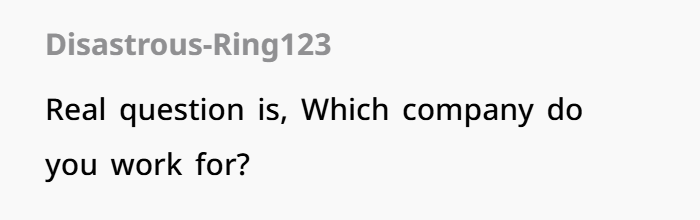


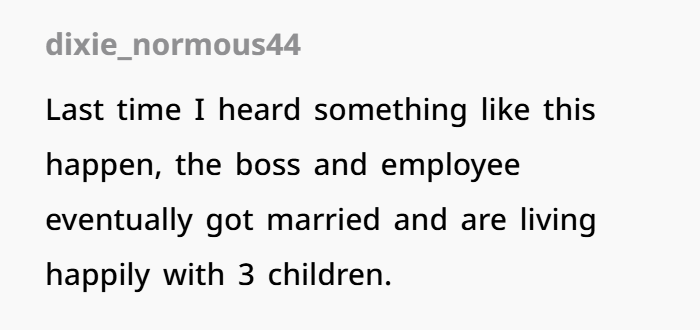
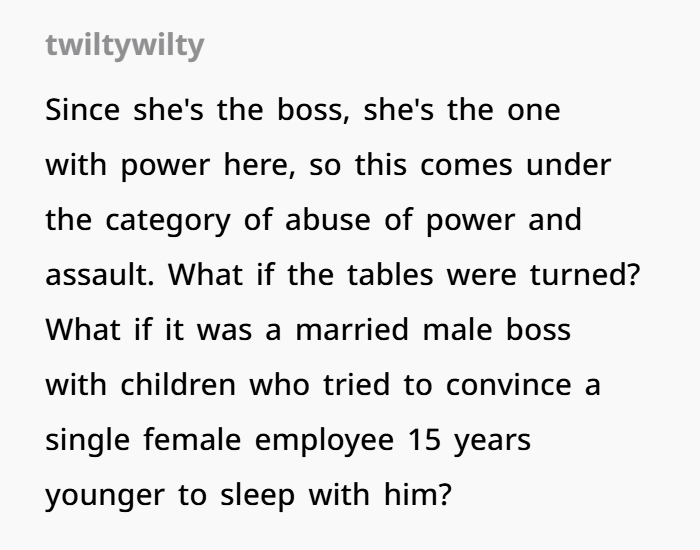


The situation also shows why a boss-employee relationship can get complicated so quickly. Even when two adults agree to something, the difference in workplace power can create questions about boundaries, favoritism, company policy, and possible HR problems.
For now, nothing in the story suggests that anyone else at work knows what happened. His boss has also kept things strictly professional since the trip.
Still, pretending those two nights never happened is much easier said than done. For the employee, the business trip ended when they left Delhi. The worry clearly did not.