Mother-in-Law Allegedly Poked Holes in Couple’s Condoms to Get a Grandson, Leaving New Mom Pregnant Just Months After Giving Birth

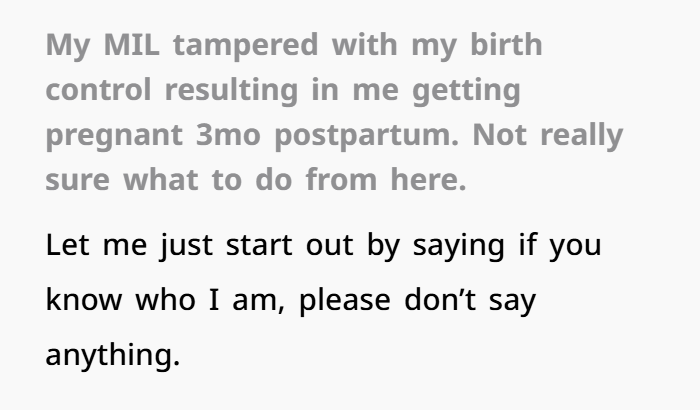
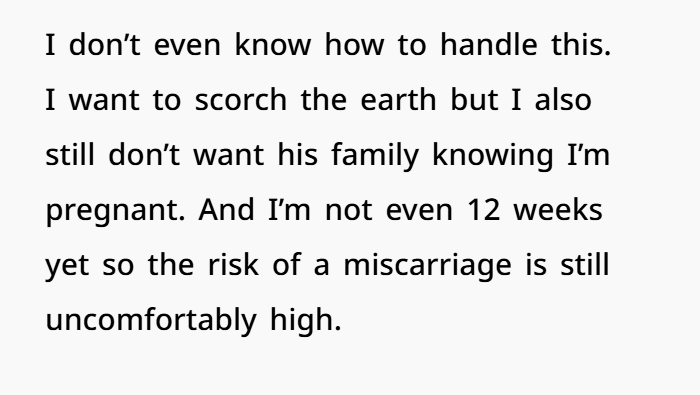
A 20-year-old mom was shocked when she learned that her mother-in-law may have secretly damaged the couple’s condoms to make her pregnant again.
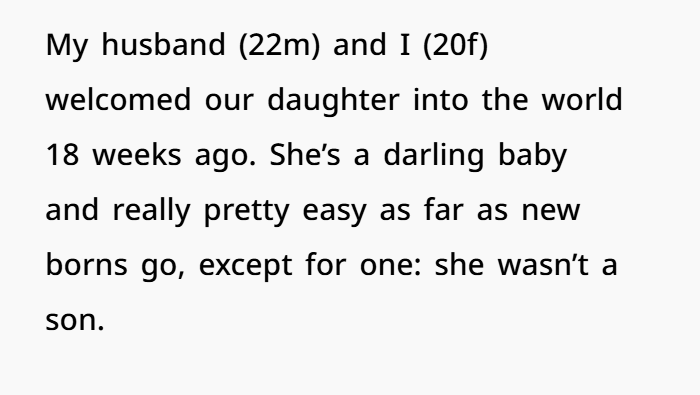
She had given birth to a baby girl just 18 weeks earlier. She and her 22-year-old husband were happy with their little daughter. But his parents wanted a grandson to carry on the family name.
Things changed when the young mom found out she was pregnant again. The couple had been careful and used condoms for birth control, so the news came as a surprise.
At first, they were happy about the new baby. But that happiness soon turned into worry when her sister-in-law shared a troubling secret.
She claimed that her mother had admitted to making small holes in the couple’s condoms since they brought their daughter home from the hospital.
The discovery left the young mother feeling betrayed, angry, and unsure whom she could trust. She wanted to welcome her second baby with happiness, but knowing someone may have deliberately taken away her choice made that difficult.












A Happy New Arrival That Wasn’t Enough for Her In-Laws
The young couple had recently welcomed a healthy baby girl. Their daughter was just 18 weeks old, and by her mother’s account, she was a fairly easy newborn to care for.
But there was one problem in the eyes of her husband’s parents.
The baby was a girl.
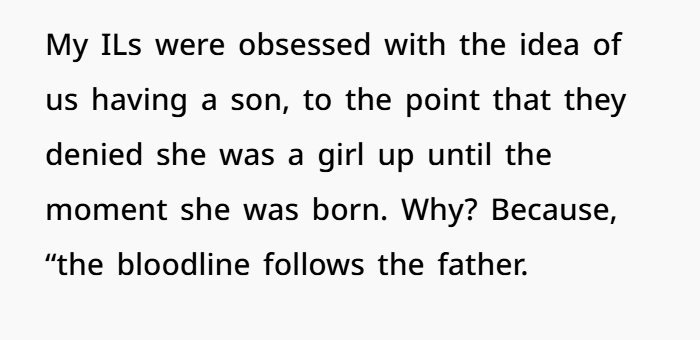
Long before the child arrived, her grandparents had convinced themselves that the couple would have a boy. They reportedly refused to accept that the baby was female until she was born.
Their reason was tied to an old-fashioned belief about family names.
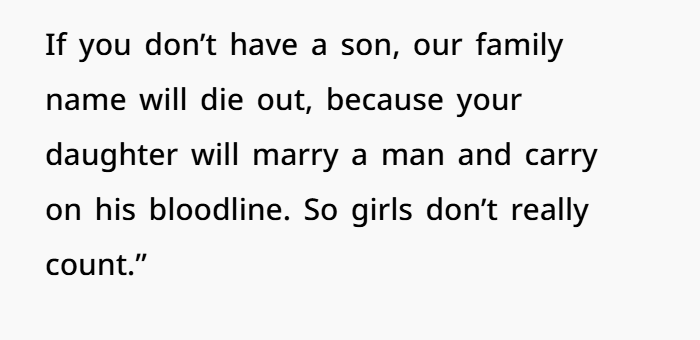
They believed only a son could carry on the father’s bloodline. In their minds, a daughter would eventually marry, take another man’s name, and continue his family instead.
It was a painful way to view a newborn granddaughter, especially when her parents were simply happy to have her.
The pressure didn’t stop after the birth.
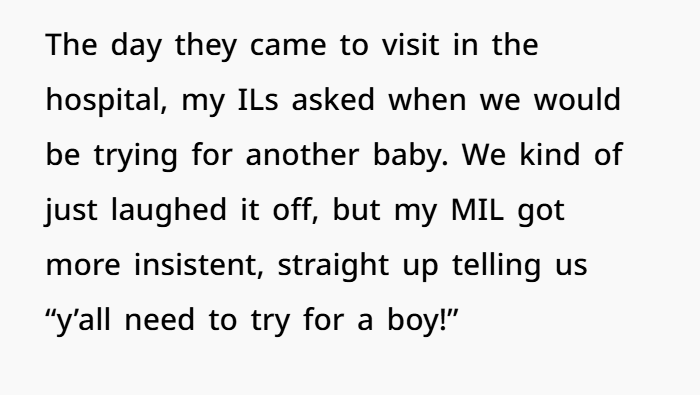
When the grandparents visited the hospital, they were already asking when the couple planned to have another child. The mother-in-law even pushed them to try again for a boy.
The young parents laughed off the comments. They had just welcomed their first baby and weren’t planning another pregnancy anytime soon.
Unfortunately, the mother-in-law didn’t seem ready to accept that answer.
The Mother-in-Law Started Visiting Every Day
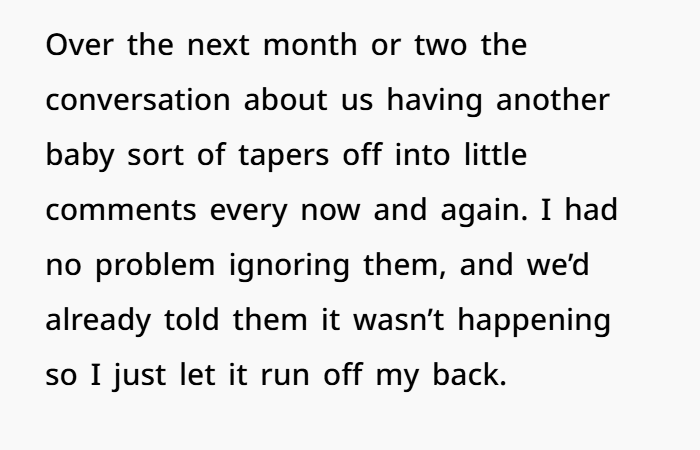
Over the next month or two, the constant talk about having a grandson slowly faded. There were still occasional comments, but the young mother tried not to let them bother her.
Around the same time, her mother-in-law began visiting the house almost every day.
At first, the help seemed thoughtful.
The new grandmother would watch the baby so her daughter-in-law could catch up on sleep. Sometimes, she would even tidy the house.
With a newborn to care for, those few hours of rest were a welcome break.
The mother-in-law was sometimes left alone in the home for one to four hours.
The young mother had no reason to think anything was wrong. She believed her mother-in-law was simply helping her through the exhausting first months of motherhood.
It wasn’t until later that those visits began to look very different.
A Sudden Feeling Led to an Unexpected Pregnancy Test
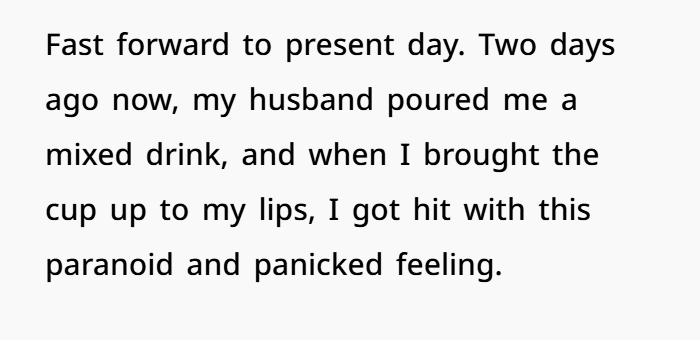
One evening, the young woman’s husband made her a mixed drink.
But just as she lifted the glass toward her mouth, she suddenly felt uneasy. Something told her to put it down.
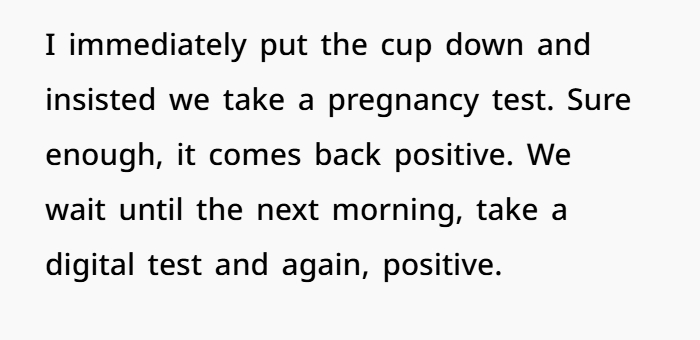
She immediately asked her husband to get a pregnancy test.
The result was positive.
Still surprised, the couple waited until the next morning and tried a digital pregnancy test.
That one was positive, too.
Based on the date of her last menstrual period, she believed she was about six weeks pregnant.
The news was unexpected, especially because she had given birth only a few months earlier.
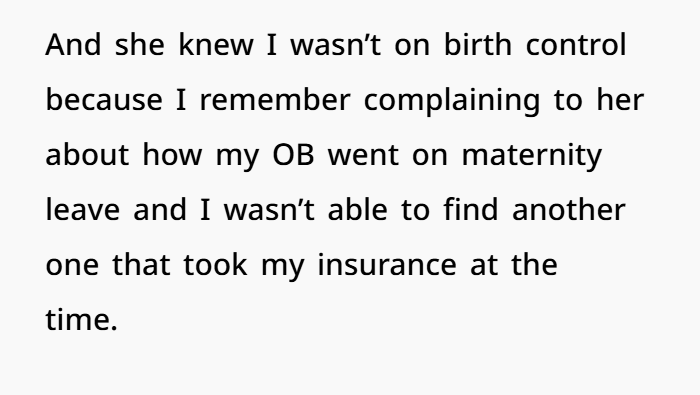
The couple had been using condoms because she couldn’t get hormonal birth control at the time. Her regular OB-GYN was on maternity leave, and she had struggled to find another doctor who accepted her health insurance.
They had also been careful about using lubricant to reduce the chance of condoms tearing.
So how had another pregnancy happened?
Condoms are not completely foolproof. According to the CDC’s contraception guidance, pregnancy can still happen when condoms are used, although correct and consistent use lowers the risk.
At first, the couple thought they might simply have experienced an unexpected birth control failure.
Despite their confusion, they were happy about the pregnancy.
They decided to keep the news private for a while. After the pressure they had faced following their daughter’s birth, they didn’t want another round of family demands.
But the young mother was especially close to her sister-in-law.
She trusted her enough to share the secret.
That conversation would change everything.
Her Sister-in-Law Broke Down After Hearing the News
When the young mother told her sister-in-law she was pregnant, she expected surprise, excitement, or perhaps a few questions.
Instead, her sister-in-law looked horrified.
Her eyes filled with tears, and she repeatedly asked whether the pregnancy was real.
The young mother assumed she was worried about their age or finances. She explained that although she and her husband were young, they earned enough money to support another child.
But money wasn’t the problem.
Her sister-in-law suddenly burst into tears and began apologizing.
Confused and worried, the young mother waited for her to explain.
Then came the accusation.
Her sister-in-law said their mother had told her she was poking holes in the couple’s condoms.
According to her account, the mother-in-law had been doing this since shortly after the family returned home from the hospital.
The sister-in-law claimed she hadn’t taken the confession seriously. She thought her mother was simply making an angry comment because she was disappointed about not having a grandson.
But now, with another pregnancy confirmed, the words no longer seemed like an empty threat.
The young mother was stunned.
Suddenly, all those visits to her home began to make sense.
The Daily Visits Took On a Disturbing New Meaning
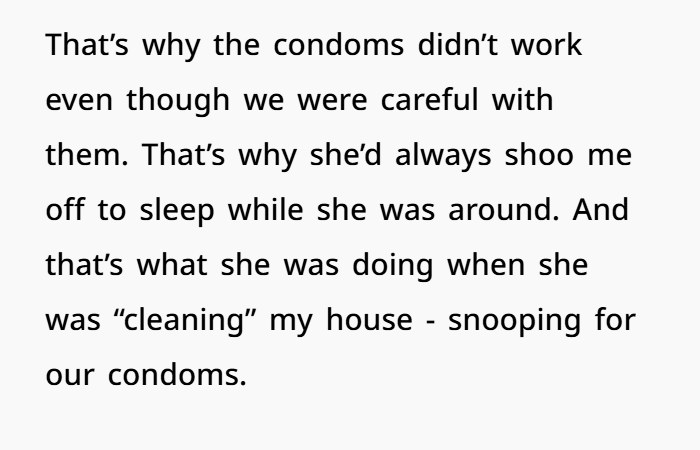
The young mother started remembering how her mother-in-law always encouraged her to go to sleep while she watched the baby.
She also remembered the cleaning.
What once looked like a kind gesture now seemed suspicious.
She began to wonder whether her mother-in-law had been searching through the house for their condoms while nobody was watching.
There was another detail that made the situation even more upsetting.
Her mother-in-law already knew she wasn’t taking hormonal birth control.
The young woman had previously complained about struggling to find an OB-GYN who accepted her insurance. She had shared that information without imagining it could be used against her.
Now she feared her mother-in-law had taken advantage of it.
The accusation has not been independently verified, and the sister-in-law’s account alone does not prove exactly what happened. Still, the young mother believed the pieces fit together.
What she had first seen as an unexpected pregnancy now felt like something that had been planned behind her back.
Why Birth Control Sabotage Is Such a Serious Concern
Damaging someone’s condoms without their knowledge is a form of birth control sabotage, which can fall under reproductive coercion.
The American College of Obstetricians and Gynecologists (ACOG) describes reproductive coercion as behavior that interferes with a person’s ability to make their own decisions about pregnancy and contraception.
This can include deliberately interfering with birth control.
In this case, the alleged interference was especially troubling because the young mother was still recovering from childbirth.
Medical guidance also explains why closely spaced pregnancies deserve attention.
The ACOG guidance on pregnancy spacing advises women to avoid pregnancy intervals shorter than six months and discusses the possible risks of becoming pregnant again within 18 months.
That doesn’t mean every closely spaced pregnancy will have complications. Many families welcome healthy babies close together.
But it does mean a new mother deserves the chance to make informed choices about her body, her recovery, and her next pregnancy.
For this young woman, that choice may have been taken away.
She Was Angry at Her Mother-in-Law, but Also Hurt by Her Sister-in-Law
The young mother struggled to understand how someone she trusted could interfere with such a personal decision.
She was furious with her mother-in-law. But she also felt deeply hurt by her sister-in-law’s silence.
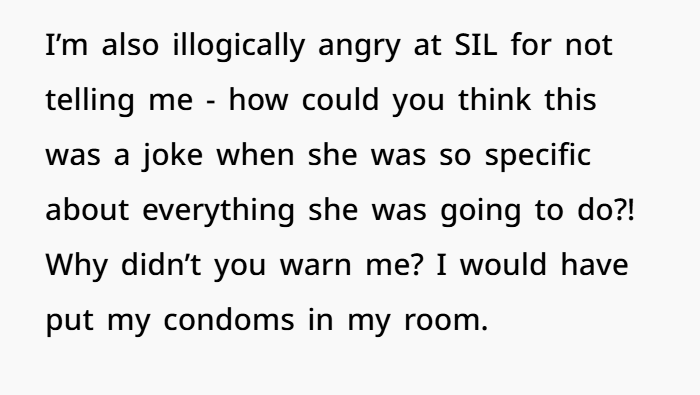
After all, her sister-in-law had heard about the alleged condom tampering before the pregnancy happened.
Why hadn’t she said anything?
Even a simple warning could have allowed the couple to keep their birth control somewhere private.
The sister-in-law insisted she had thought her mother was joking. But the young woman found that explanation difficult to accept.
She was also dealing with complicated feelings about her pregnancy.
She wanted to be excited about having another child. She and her husband could afford another baby, and they were looking forward to growing their family.
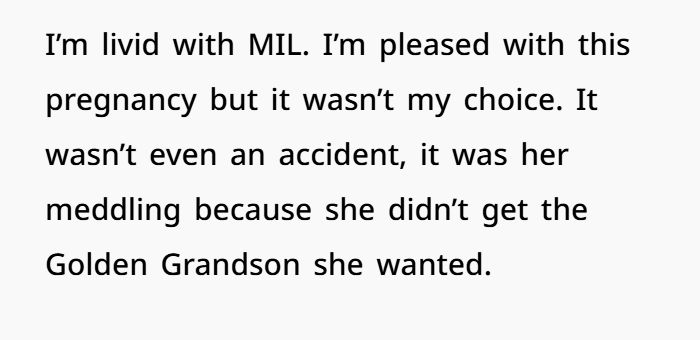
But the thought that someone else had made that decision for them was painful.
She also worried about miscarriage because she was still early in her pregnancy.
What should have been happy news had become mixed with fear, anger, and disappointment.
Her Husband Finally Saw His Mother’s Behavior Differently
There was one positive change in the middle of the family drama.
Her husband appeared to understand just how serious his mother’s alleged actions were.
The young woman described him as finally coming out of the FOG, a term sometimes used to describe the fear, obligation, and guilt that can keep people tied to unhealthy family relationships.
For her, it was a major turning point.
She no longer felt that she had to convince her husband that his mother’s behavior was unacceptable.
He was ready to support her decisions about what happened next.
That support mattered, especially because the couple still had a newborn daughter to protect while preparing for another baby.
The Young Mother Shared an Update and Made a Difficult Decision
After receiving advice and support online, the young mother returned with an update.
She first cleared up some confusion about her age and pregnancy timeline.
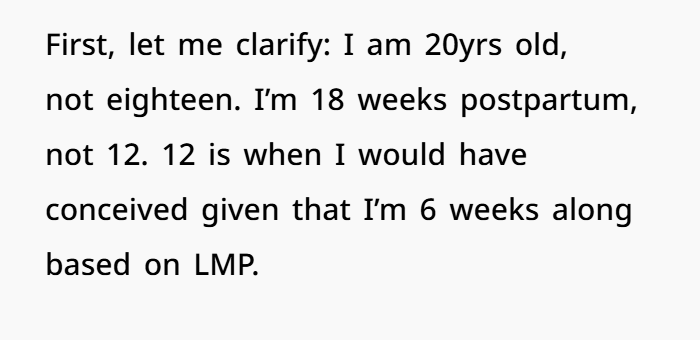
She was 20 years old, not 18. She was also 18 weeks postpartum and believed she was six weeks pregnant based on her last menstrual period.
That meant she estimated she had conceived around 12 weeks after giving birth.
She also responded to people questioning whether her story was real.
The accusations had clearly upset her. She explained that she wished the situation hadn’t happened and had come online looking for support, not judgment.
But she was feeling a little less overwhelmed now.
She had started making a plan.
She Decided to Cut Contact With Her Mother-in-Law
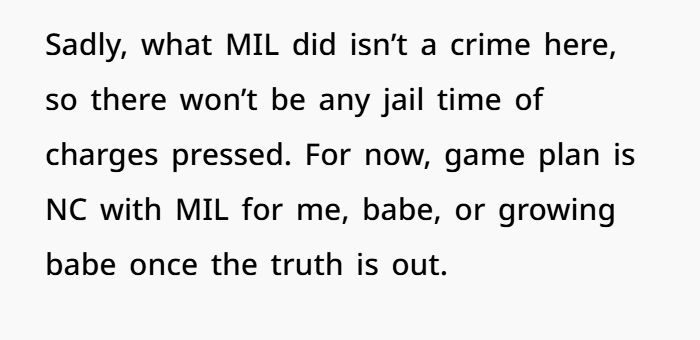
The biggest decision was to stop contact with her mother-in-law.
The young mother planned to keep both her daughter and her unborn baby away from their grandmother once the situation became known.
She didn’t want someone she believed had interfered with her birth control to have access to her children.
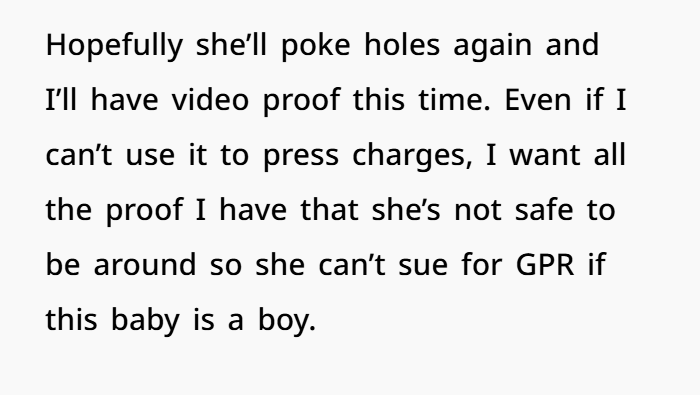
But before confronting her mother-in-law, she wanted evidence.
Her sister-in-law’s account had raised serious concerns, yet she wanted something more concrete.
She decided to order a hidden camera and buy new latex-free condoms.
Her plan was to tell her mother-in-law that she had developed a latex allergy. She hoped that, if the alleged tampering happened again, the camera might capture it.
The plan came from her account and was not reported as something she had already carried out.
It also raises privacy and legal concerns. Recording laws differ by location, so hidden-camera evidence is not automatically lawful or usable in court.
She Was Also Worried About Grandparents’ Rights
Another concern was whether her mother-in-law might eventually try to seek court-ordered contact with the children.
The young woman referred to this as GPR, meaning grandparents’ rights.
She was especially worried about what might happen if her second baby turned out to be a boy.
Because her in-laws had been so focused on having a grandson, she feared they might become even more determined to stay involved.
She wanted evidence of the alleged birth control sabotage in case a future family court dispute developed.
In her update, she said she believed her mother-in-law’s actions were not a crime where she lived, meaning she didn’t expect criminal charges or jail time.
However, her location and local laws were not provided, so that legal conclusion cannot be independently confirmed.
Grandparents’ visitation rights and family court rules depend on the jurisdiction. A claim for visitation does not automatically mean a grandparent will receive it.
The young mother’s concerns were understandable, but the story did not establish whether her mother-in-law had any legal basis to seek visitation.
She Even Wanted to Change the Family’s Last Name
The young mother also came up with another way to respond to the pressure over having a grandson.
She wanted to change the family’s last name.
Her in-laws had made such a big issue out of carrying on the family name that she no longer wanted her children to have it.
She didn’t seem concerned about what the new surname would be.
She simply wanted it to be something different.
It was a personal decision, driven by frustration over how her daughter had been treated and how much importance the grandparents placed on having a boy.
Of course, changing a family name involves legal paperwork, and the rules vary depending on where a family lives.
At the time of her update, this was still a plan rather than a completed change.
Her Husband Was Ready to Stand Beside Her
Despite everything, the young mother had one source of comfort.
Her husband was supporting her.
She explained that he was willing to follow her lead when it came to dealing with his mother.
At the time of the update, he was asleep, and she planned to discuss the next steps with him over breakfast.
The couple had not yet confronted the mother-in-law, and the pregnancy was still being kept private.
There was also no confirmed evidence presented in the story showing that the mother-in-law had physically damaged the condoms.
The young mother was still trying to work out how to protect her family without letting the situation destroy her happiness about her pregnancy.
What This Story Says About Trust and Family Boundaries
This story goes beyond an argument between a mother-in-law and daughter-in-law.
It shows how painful family pressure can become when someone refuses to respect a couple’s decisions about having children.
Wanting a grandson is one thing. Allegedly interfering with contraception to make that happen is something far more serious.
As ACOG explains in its guidance on reproductive coercion, birth control sabotage can take away a person’s ability to make informed choices about pregnancy. ACOG
The story also highlights the need for access to reliable family planning services, health insurance coverage, and postpartum medical care.
The young mother had already struggled to find an OB-GYN who accepted her insurance. That made her birth control options more limited during a time when she was still recovering from childbirth.
According to the CDC’s birth control information, different contraception methods have different failure rates, and patients can discuss suitable options with a healthcare professional. CDC+1
For someone facing suspected contraceptive interference, confidential medical advice and appropriate legal guidance may also be helpful.
A Second Pregnancy She Wants to Celebrate
One of the saddest parts of the young mother’s account is that she genuinely wants to be happy about her second baby.
She isn’t saying she doesn’t want the child.
She is upset because the pregnancy may not have happened on her terms.
She had hoped to enjoy more time with her daughter before thinking about another baby. Instead, she was facing a new pregnancy, a painful family betrayal, and the possibility of cutting off her children’s grandmother.
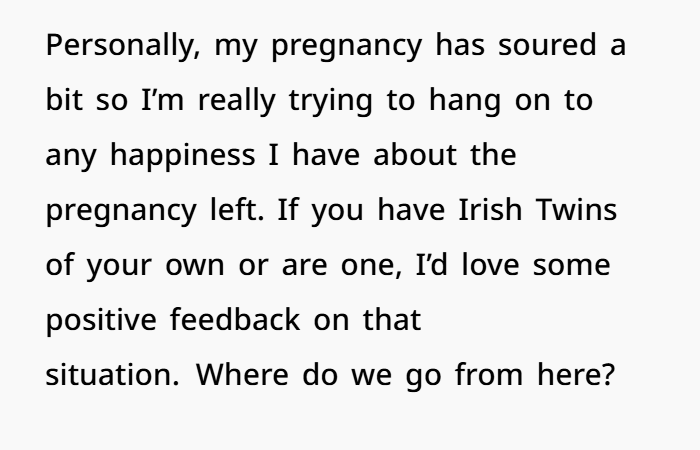
She also asked other parents with children born less than a year apart, often called Irish twins, to share positive experiences.
That small request says a lot.
Even while feeling furious and hurt, she was looking for something hopeful.
For now, the story ends with the couple preparing to discuss their future together. There is no confirmed follow-up showing whether the mother-in-law was confronted, whether further evidence was found, or what happened with the pregnancy.
What remains clear from the young mother’s account is that she wants to protect her children, rebuild her peace of mind, and find a way to feel excited about becoming a mother again.
And whatever happens with her in-laws, she wants the decision about her family’s future to belong to her and her husband.
See the comments to know what people said
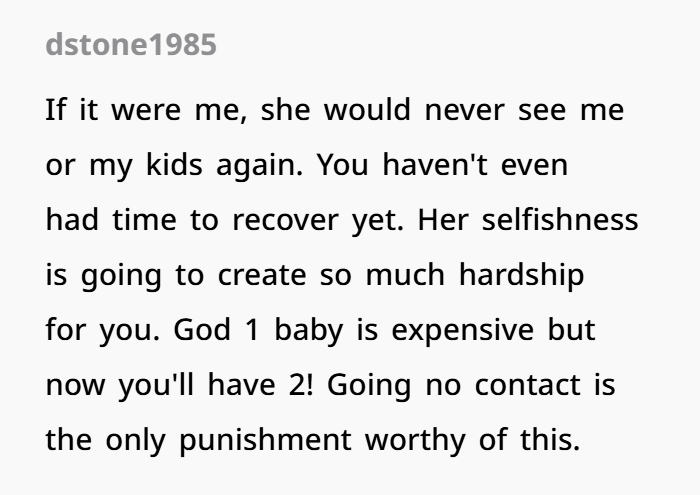

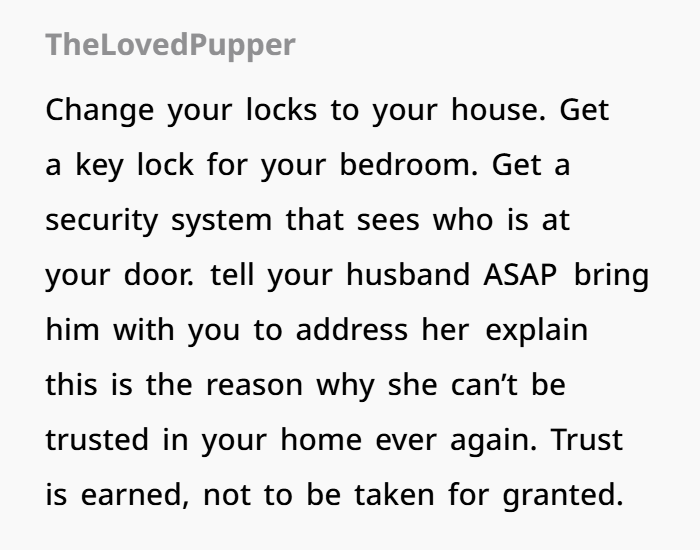

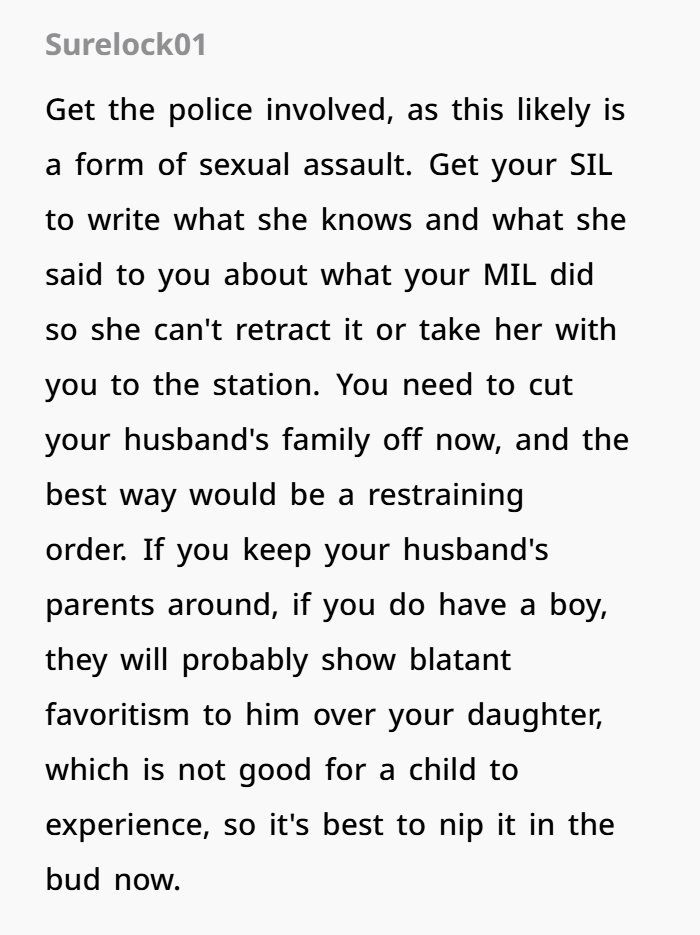

What should have been a happy surprise turned into a painful family situation. The young mother was excited about welcoming another baby, but the thought that her mother-in-law may have secretly interfered with her birth control left her feeling angry and betrayed.
Her biggest concern now is protecting her children and keeping her family safe. With her husband’s support, she plans to set firm boundaries, gather evidence, and distance herself from her mother-in-law.
The story is also a reminder of how serious birth control sabotage and reproductive coercion can be. No family member should interfere with a couple’s personal decisions about pregnancy, no matter how badly they want a grandson.
For now, the young mother is trying to find happiness in her unexpected pregnancy while dealing with the hurt caused by someone she once trusted.
The future remains uncertain, but one thing is clear: she wants to raise her children in a home where love, respect, and personal choices come first.