
Parents Assume Theme Park Offers Free Childcare, Hand Their Baby to a Random Employee and Disappear
I used to work at a well‑known theme park resort in Florida (yes, the kind of place with the big mouse logo and magical vibes). During a hectic lunch rush, I was heading to the cash register when a little girl tugged at my shirt. She was adorable: chubby cheeks, big blue eyes, no hair yet. Her mother smiled and encouraged me to pick her up because apparently the baby never did that with strangers. So I said “just for a second,” and hoisted her onto my hip—and poof the family vanished into the crowd. The mom, dad and grandma just walked off and left the baby in my arms while I wandered around holding her for half an hour, trying to find them. Eventually I flagged down a manager, who shrugged and said “it’s on you now to find them.” I finally spotted grandma trying to leave, reclaimed the baby and gave her back. It was wild. The takeaway? Don’t ever hold a stranger’s infant—even if the parents invite you to.
Visiting the big theme park could be someone’s lifelong dream but many people in fact lose their heads after this dream comes true

The author of the post is an employee in a famous theme park in Florida and recently she ran into a family with a baby during her working day
Okay, so now we dig into the nitty‑gritty. Why was this incident more than just “weird”? What are the risks here? What are the legal and ethical implications? I’ll keep this casual but grounded in real facts.
Risk, responsibility and unexpected roles
Working at the resort meant you meet all kinds of people all day—families, kids, parents, full‑on chaos. You might chat with little ones, maybe hand them a balloon, but picking one up? That’s stepping into a different zone. You suddenly become a caregiver to someone else’s child. You’re responsible (even if you don’t want to be) for that baby’s safety until the original caregiver returns. That’s heavy.
In the theme‑park scenario, the crowd is large, movement is constant, distractions everywhere: rides, food lines, packages, strollers, people everywhere. Losing track of a parent or family is dangerously easy. The parents handing the child off—and walking away—removed themselves from responsibility and placed it on me (the employee) by default.

Legal backdrop: child abandonment & duty of care
Legally in the U.S., the term Child abandonment covers when a parent or guardian deserts a child or fails to provide care and supervision. FindLaw+1 It’s treated seriously—especially for infants or if the child is left in unsafe conditions. PMC
In this incident, the parents may not have intended abandonment in the criminal sense, but handing off the baby without clear supervision or contact introduces risk. There was no name, no “I’ll be right back,” no supplies left behind—just a tiny child with someone she didn’t know. If something went wrong (injury, missing child, worse), liability could fall in unexpected ways.
Even for employers or venues (theme parks, resorts), there’s a duty of care: staff should ensure minors are supervised, not left alone or in inappropriate hands. For example, a news source noted at Walt Disney World Resort a child was found attempting to enter a park alone, triggering staff intervention. Disney Fanatic While that’s a different scenario, it reflects how parks take (or should take) safeguarding seriously.
Case studies & relevance
One academic article described how some child‑abandonment cases don’t even get legal attention—when the child is left with an identifiable caregiver, the abandonment is less likely to be prosecuted, yet the moral and psychological risks remain. PMC For example:
“A child is officially abandoned only when both parents abandon him or her. When one parent takes parental responsibility, the child is not officially regarded as abandoned.” PMC
Although the setting is different, parallels are there: left in the hands of someone else briefly, without proper context, the child’s welfare depends on that “someone else”—in this story, me, a total stranger to the baby.
Also, theme‑parks and resorts cater to high volumes of guests and a lot of minor supervision issues happen. One forum post described many guests just stepping away from strollers or children in park crowds and expecting staff to handle things. Reddit It shows how this kind of “dropping off” behaviour isn’t entirely unique, even if socially frowned upon.
The grey area: moral vs legal fault
In the story you shared, I don’t think the parents intended to commit a crime. They may have trusted the staff member (you) implicitly, thought “you’re a nice employee” and wandered off. But the result was handing over a baby to someone unknown and leaving. That is morally risky. If I were advising a resort, I’d say: “No employee should accept custody of a child without verification, and parents should never assume an employee will look after a child for them.”
From your end, you were placed in no‑win territory: you didn’t sign up as child‑care, you were doing food service, and you didn’t know the family. The manager’s response (“That’s all you! You have to find her parents.”) shows failure at organisational level: no clear protocol, no communication, you as staff lacked support.
What this means for workers, parents and venues
For staff/workers:
- You’re not necessarily trained to supervise children or act as a guardian. If someone hands a baby to you, you should politely decline or immediately escalate to security or management.
- Document what happens: time, baby’s description, parents’ description, location. This protects you.
- Ask for help: don’t wander aimlessly with a baby in a crowd for 30+ minutes. That’s unsafe for both you and the child.
For parents/guardians:
- Even in a crowd or magical venue, you are responsible. You cannot hand a toddler or infant to a stranger (employee or not) and vanish.
- If you need to step away: remain in view, leave contact info, keep child in safe place or with known adult.
- Understand that just because someone smiles and picks up your baby—even politely—it doesn’t mean they’re willing or trained to care for them.
For venues/theme parks/resorts:
- They should have clear policies: staff should never accept unsupervised children without verification.
- Should train staff on what to do when someone hands them a child: e.g., “Escort them to security, don’t carry them around yourself.”
- Should enforce parent‑supervision rules: children must remain with parents or designated adult at all times unless registered for child‑care.

Why this story resonates (and why kids pick you)
You mentioned kids often gravitate toward you, which you found surprising. That actually plays into the theme‑park dynamic: children feel comfortable with friendly faces, especially when surroundings are high‑energy, bright, fun. A pleasant employee blocking crowd flow, interacting with kids—makes sense kids latch on. But that also increases the risk: when children approach staff, parents assume: “Oh you’re interacting, must be safe.” And staff may feel obliged to respond kindly.
Your sense of nervousness with children – wanting to be polite yet unsure – is totally valid. Everyone wants to help, be friendly, but unless you’re trained in childcare or working in a dedicated kids‑area, the role shifts from “friendly employee” to “temporary caregiver” in a blink. And you didn’t choose that role; it was thrust on you.
The end result: you decided “no more holding kids, not even for a second.” That’s a strong boundary and wise. Kindness doesn’t mean babysitting.
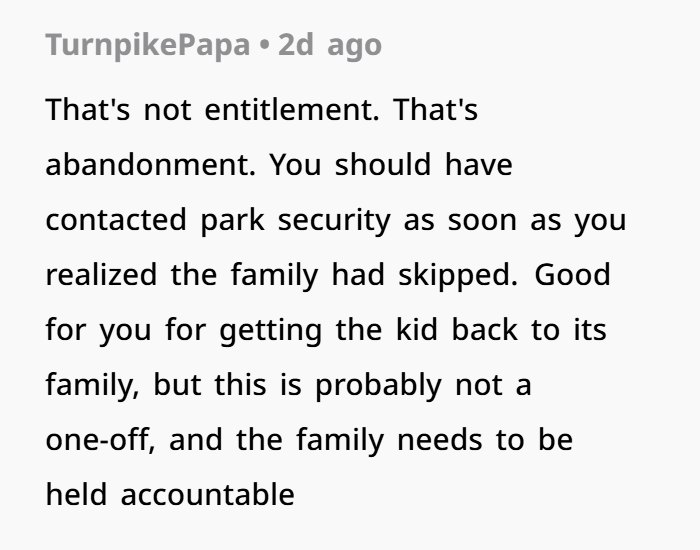
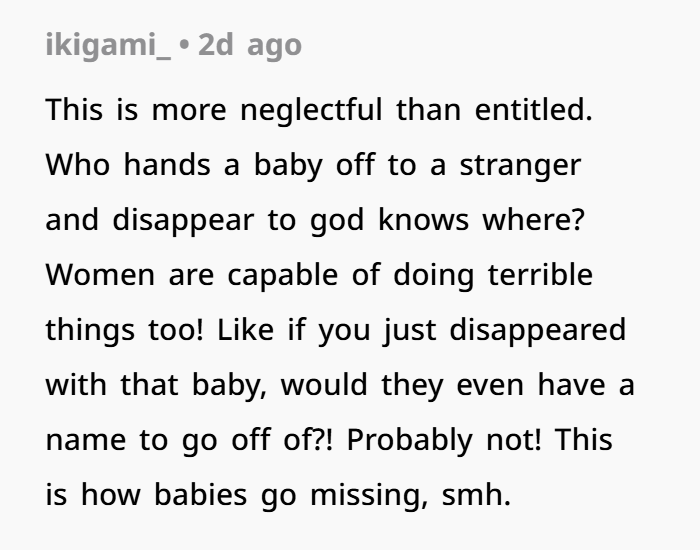
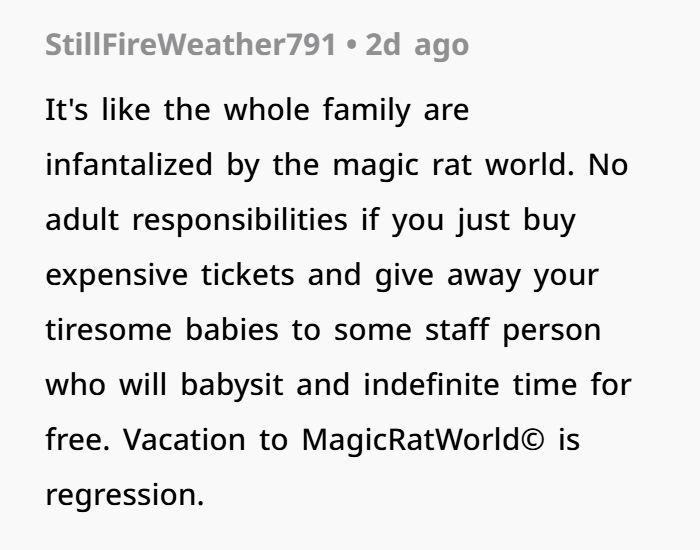
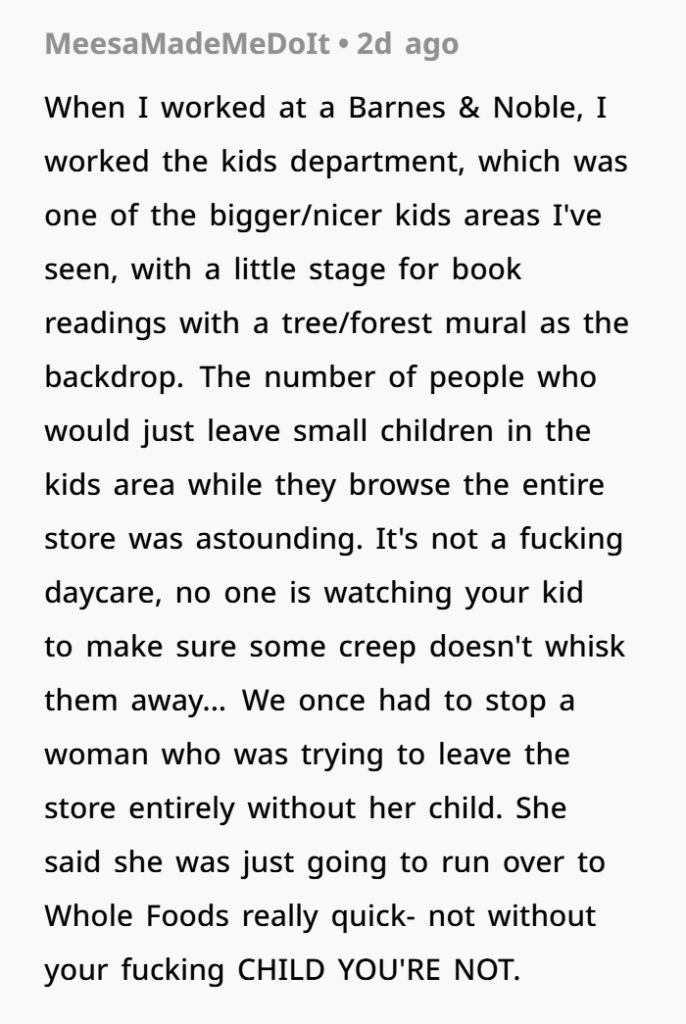
Most commenters agreed that this case in fact showed blatant parents’ neglection and noted that the police should’ve been involved here


This was a wild, unforgettable moment. But it also serves as a cautionary tale. In retail, theme‑parks, food service—staff may be friendly, nurturing, but they are not stand‑in parents. Crowd settings magnify risk. When a family disappears and you’re left holding an infant you don’t know, the only safe move is escalation: alert security, keep baby safe, find the guardian—not wander hoping they’ll return.