
AITA for telling my SIL to walk her daughter to school?
I’m 23 F, a university graduate working in healthcare with irregular shifts, living with my mum in her paid‑off house. My brother (31) and his wife “Rose” (31) plus their daughter (6) just moved in temporarily because their new home has major problems. On day one, Rose asked if I could drop their daughter at her school (5 min drive from the hospital I sometimes work at) every day. But my shift times often clash (overnights, early mornings). I said I couldn’t commit to it. I suggested instead that she walk the daughter 15 minutes down the road (safe route) because I just don’t have the availability. Rose got upset, my mum kind of tried to mediate, my brother called me selfish. Now I’m wondering: am I really that selfish? Am I the asshole here?
To many, a short walk sounds much better than having to rely on someone else to drive them

But this woman’s sister-in-law expects her to take her child to school every day instead of doing it herself




Alright, let’s dig into several layers of this. I’ll talk about boundaries, expectations, fairness, logistics, work‑life balance, and family obligations. Let’s keep it conversational, human, and casual.
Setting & boundaries
You’ve got a complex situation: you live with your mum, you pay rent (at a discount), you do most of the housework, you work irregular shifts in healthcare (which is demanding). So you’re not free 24/7. When Rose asked you to add a daily school drop‑off to your responsibilities, that effectively means a commitment of ~8 am every weekday (the daughter must be at school by then). That’s a big ask given you might be finishing an overnight shift at 9‑10 am, or starting early and therefore unavailable for drop‑off.
Most people would expect that kind of daily commitment to be formally agreed, maybe compensated, or at least reciprocated. It’s not a small favour if it happens every morning. It becomes part of your obligations. And you said “I can’t commit to this everyday.” That’s fair. You’re being honest about your constraints.
Work & availability
Irregular shift work is notoriously difficult to schedule around other people’s non‑flexible schedules. You can’t just flip your availability without consequences. You even said your job: if you ask for restricted availability, they give you way less shifts. So if you told your boss “I can’t do mornings anymore because I have to drop a kid to school”, you risk reducing your income or shift count. That means the ask is not just logistical, but can have real impact on your job and finances.
It’s reasonable to decline an ask that jeopardises your stability. Also, you’re not the parent of the child. You’re a sibling living in the house, doing your own work and paying rent. The primary responsibility lies with the child’s parents (or legal guardians) unless you formally take on that role.
The alternative suggestion & fairness
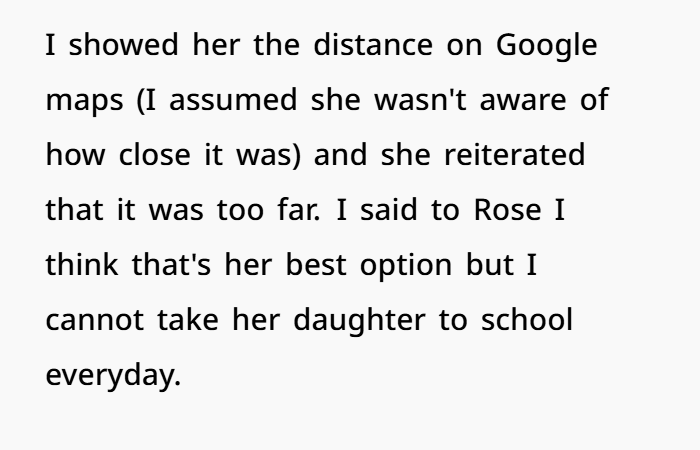
You told Rose the 15‑minute walk is a viable option. You showed her via Google Maps how close the school is, emphasising that it’s safe and walkable. She dismissed it, saying “too far to walk with a young child.” Now: is 15 minutes a stretch with a 6 year‑old? Depends on the child, weather, local sidewalks, but it is absolutely within many families’ normal routines. You’re saying: “I cannot take this on; I think the walk is your best option.” That is not outrageous.
Rose’s reaction – upset that you won’t do it – suggests she expected you to drop everything and help. But expectations don’t always match reality. Family sometimes imposes assumed obligations (“since you live here, you’ll help with the kid”) which may seem normal in some households—but you’re allowed to say no, especially given your own commitments.

Family dynamics & temporary living arrangements
Since they moved in temporarily due to home repairs, you might feel a bit on the hook for extra help. But “temporary living under one roof” doesn’t automatically mean “you’ll take on my child care logistics.” Your mum’s house and mortgage arrangement is such that you already contribute rent and chores. That’s generous on your part. It isn’t realistic to expect you to shift your entire schedule for their drop‑off.
And your mum recognised your irregular shifts: she told you she understood when you said no. That signals you have internal support for your boundary. The fact your brother called you selfish speaks more to his frustration than to your wrongdoing.
Moral & parental responsibility
When it comes down to it: dropping a child to school is parental responsibility or guardian responsibility: getting them ready, walking or driving them, coordinate logs. The ask to outsource that everyday to someone else is heavy. Especially when you’ve got your own adult life and job. You’re not a professional caregiver in this context; you’re a family member helping. But help should be mutual, balanced, possible. It’s okay for the parents to step up.
Your suggestion (walking) means they still fulfil the primary duty rather than delegating it completely. You’re not refusing all help (you didn’t refuse about other things) just refusing a routine commitment that doesn’t fit your schedule.
Potential negative impacts & what they feel
From Rose’s perspective: She’s stressed. Their home is uninhabitable currently (issues with toilet, shower, heating) and they’ve moved in. She might feel overwhelmed. She only works one shift a week, so morning school drop‑off falls onto her or neighbour ideally. She lost neighbour help. Her husband starts at 7am, uses car share. So she might genuinely feel stuck and need help. Her ask, “just help me” reflects stress, not malice.
But help still needs to consider the helper’s limitations. You are also under stress working healthcare shifts and living at home. She might not view it as your priority, but rather a favour she needs. And you think she can walk the daughter. That discrepancy is the heart of the conflict.
Social expectation & emotional labour
There’s also the element of emotional labour: you’re expected to accommodate the family’s needs out of goodwill and shared living. Family scenarios often blur lines between “helping” and “taking on duty.” The fact you were asked without discussion of how it affects you means you weren’t looped into the decision‐making. That’s tricky.
Also, you’re paying half market rent, doing housework—so you’re already contributing. It’s reasonable that you draw a line at a large daily commitment—especially one outside your job/contract.
Compromise possible & future steps
You could offer some help: perhaps on days you’re not working early or night shifts, you might assist. But free commitment every day is too much. You could say: “I can drop her X days a week when I’m free, but on other days you’ll walk or arrange something else.” That shows willingness but keeps boundaries. Rose might be more receptive.
Also propose alternate solutions: maybe neighbour one day a week, car‐pooling with another parent, or splitting walk vs. drive. That alleviates the burden and shares responsibility.

Final assessment
Given all this, you’re not the A‑hole. You set a reasonable boundary, explained your reasons, suggested a viable alternative, and you’re not refusing all help. The expectation placed on you by your brother/SIL seems disproportionate given your situation. They might feel urgency, but that doesn’t make your refusal wrong.
They might view you as “selfish” because their perspective is “we need help” but from your vantage point you’re juggling job, living at home, chores. Your decision is fair.
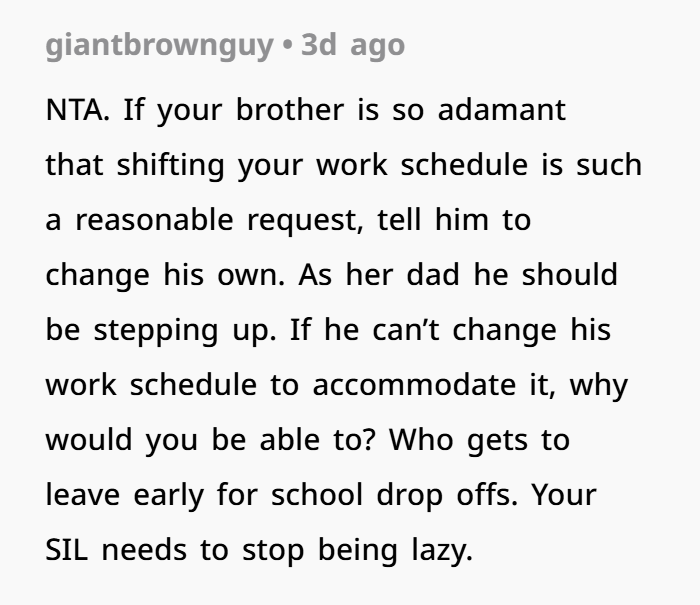
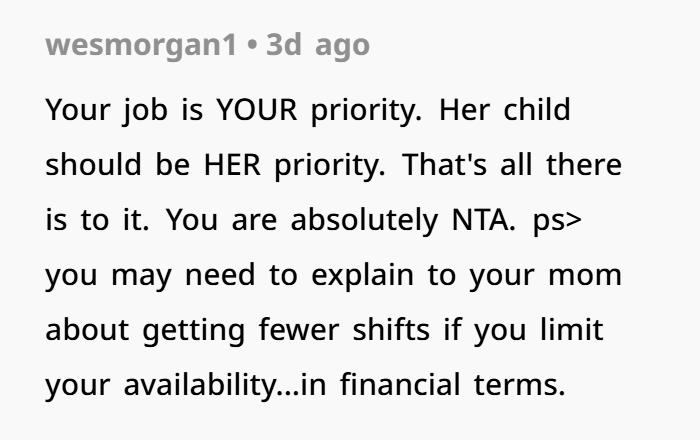
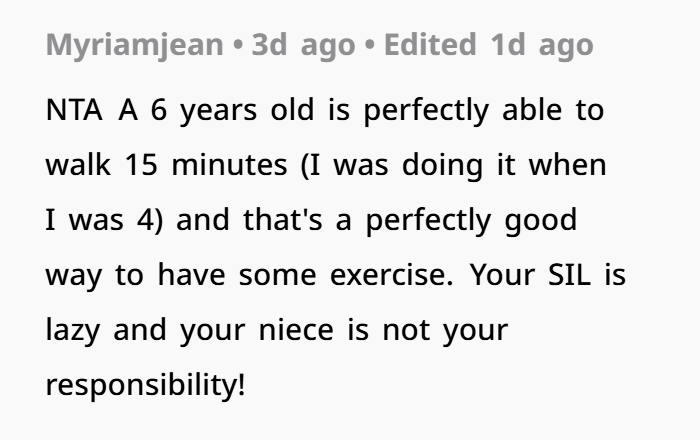
People who read this particular story said the aunt cannot be blamed for refusing to help with her niece




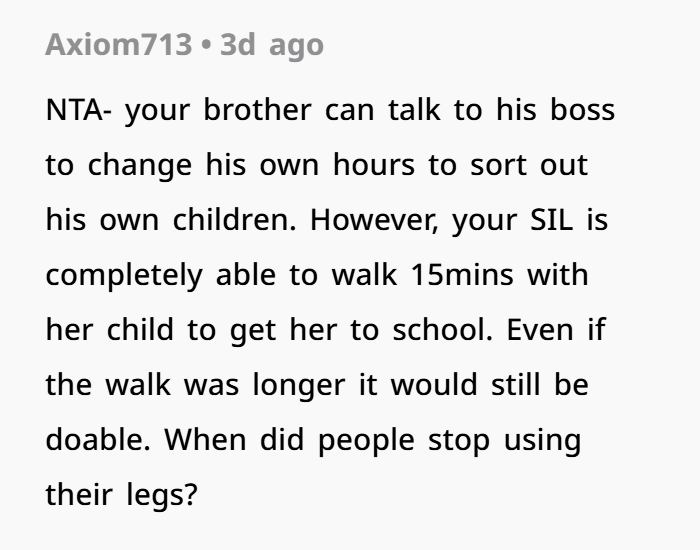

So to answer your question: No, you’re not the asshole. You’re justified in saying you can’t commit to every morning drop‑off given your irregular shifts. You suggested a walk that is practical. The parents have primary responsibility. The family will need to figure out their logistics given the move and schedule clash.
Still, you might soften the tension by: offering help when you can, communicating clearly your limitations, and suggesting alternate solutions. That might preserve the relationship and ease their stress without you sacrificing your own workload or boundaries.