Pregnant Woman Checks Partner’s Phone—and Finds MIL Asking for Her Bank and Medical Information


At first, it was just a feeling. A woman who was six months pregnant noticed that her partner was suddenly speaking to his mother all the time. Calls came several times a day, texts never seemed to stop, and he often walked outside to answer the phone. She couldn’t understand why so many conversations had to happen away from her.
Then she checked his phone and found a different kind of problem. His mother had been asking questions about the woman’s bank accounts, monthly bills, job, pregnancy, medications, and medical appointments. Some requests were very personal, including banking details and photos of medication. The woman felt that important boundaries around financial privacy, bank account security, and private health information had been crossed.
She was also upset by comments about her and her family. When she confronted her partner, he said his mother had good intentions and that he had defended her when needed. Still, the explanation didn’t make her feel better. Trust can be hard to rebuild when personal financial information and private medical details are shared without clear permission.
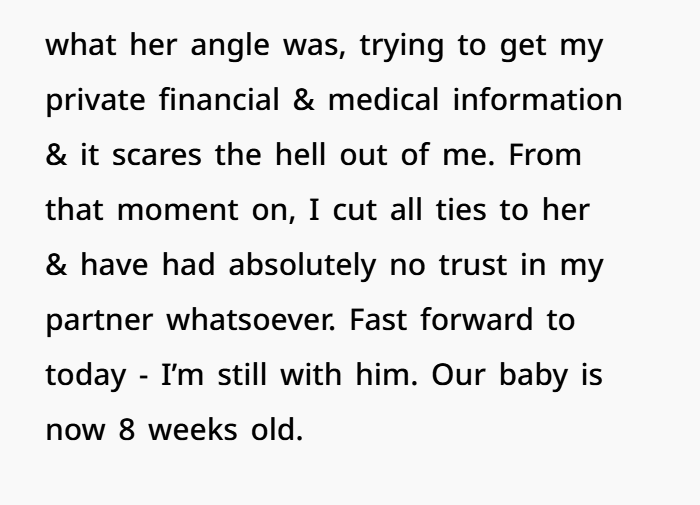
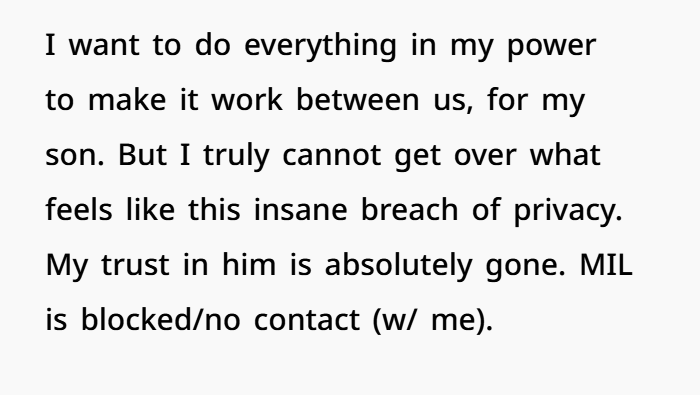
Four months have passed, and their baby is now eight weeks old. The couple remains together, but things aren’t back to normal. She worries that information about every paycheck, medical choice, household budget, or financial planning decision could be shared again. She hopes they can move forward for their family, but she’s left asking whether clear boundaries and relationship counseling can repair such a serious loss of trust.








This Is More Than a Difficult Mother-in-Law
The biggest problem here is not simply that the mother-in-law does not like her son’s partner.
Families disagree. Relatives may complain about each other. Sometimes people say things they should not say.
But this situation appears to go much further.
According to the woman, very private information about her life was being collected and discussed without her knowledge.
This reportedly included information about her bank accounts, debts, medication, pregnancy, and prenatal medical appointments.
That makes this a serious issue about privacy, trust, and personal boundaries.
A Privacy Violation Is Not Always a HIPAA Violation
There is an important difference between a personal privacy violation and a HIPAA violation.
In the United States, HIPAA mainly applies to certain health-care providers, health plans, and their business associates.
It generally does not stop an ordinary person from repeating medical information they already know.
For example, if someone tells a family member about a health condition and that family member shares the information, it may feel like a serious betrayal.
But that does not automatically make it a HIPAA violation.
The situation can be different when protected medical information comes directly from a health-care provider or medical records.
She Can Ask Her Medical Provider About Privacy
If the woman is worried about who can receive information about her medical care, she can speak directly with her health-care providers.
She can ask who is currently authorized to receive information.
She can also clearly tell the medical office who should not receive information about her care.
This may be especially important for sensitive information involving pregnancy, prescriptions, medication, mental health care, or other private medical matters.
She can also ask the medical practice to explain its privacy procedures.
The main point is simple.
A patient should understand who has access to their health information and what permissions are currently in place.
The Banking Information Is Also Important
The financial side of the story deserves separate attention.
Asking about someone’s monthly expenses is already personal.
Asking for bank account and routing numbers is much more sensitive.
Banking information should be protected carefully.
Whatever the mother-in-law’s reason may have been, the woman has good reason to review her financial security.
She can make sure her online banking uses a strong and unique password.
She can enable multifactor authentication if her bank offers it.
She can also review recent account activity and make sure financial statements and login details are not available through shared devices or accounts.
These are useful bank account security steps even when there is no evidence that money has actually been taken.
Protecting Financial Accounts Can Provide Peace of Mind
Personal financial information can connect to many parts of someone’s life.
That may include checking accounts, savings accounts, credit cards, loans, investment accounts, retirement savings, and other financial products.
If someone is concerned about unauthorized access, reviewing account security can provide additional peace of mind.
They may want to change important passwords, check which devices are signed into their accounts, and turn on transaction alerts.
If there is a reason to worry about possible misuse of personal financial information, they can also consider reviewing their credit reports and learning about available credit monitoring or identity protection options.
Taking security precautions does not mean fraud has happened.
It simply means sensitive financial information is being treated carefully.
Her Partner’s Explanation Does Not Fully Solve the Problem
The partner reportedly said that his mother’s concerns were not important.
He also said he went outside during phone calls because he did not want his partner to worry.
Maybe he believed he was protecting her from unnecessary stress.
But there is a problem with that explanation.
Keeping those conversations secret also meant she did not know that private details about her life were being discussed.
Even if his mother believed she was helping, good intentions do not automatically create permission to receive another adult’s private financial or medical information.
That is the bigger issue.
Trust May Depend on What He Does Next
The woman now has to decide whether she can rebuild trust with her partner.
The important question may not simply be, “Can I forgive him?”
It may be, “Does he understand why this was wrong?”
An apology is one step.
Changing the behavior is more important.
He would need to understand that his partner decides who receives her personal information.
He would also need to stop sharing private details without her permission.
Clear boundaries with his mother would be important too.
If information has already been shared, being open about what was disclosed may help his partner understand the full situation.
Couples Counseling Could Be Worth Considering
A relationship can sometimes recover after trust has been damaged.
But rebuilding trust usually takes time.
Couples counseling or relationship therapy could give both partners a private place to talk about what happened.
They could discuss family boundaries, medical privacy, personal finances, communication, and trust.
A couples therapist may also help them create clear rules about what information can be shared with relatives.
Counseling does not guarantee that a relationship will work.
But it may help both people understand whether the relationship can be repaired.
She Is Only Eight Weeks Postpartum
There is another important part of the story.
The woman is only eight weeks postpartum.
She says she continues to feel afraid and keeps thinking about the negative things that were said about her.
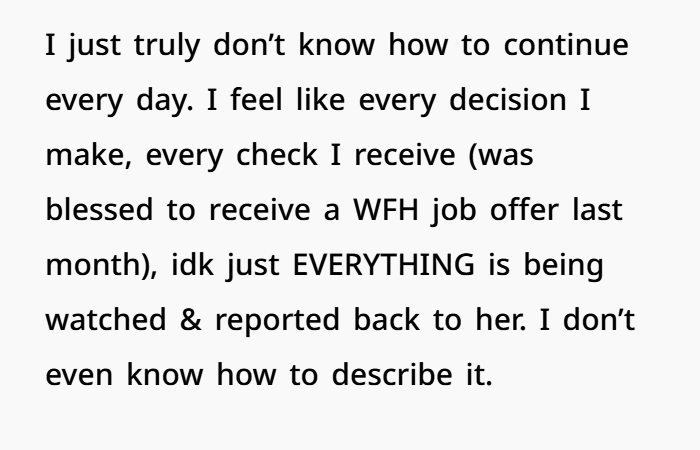
She also feels as though her actions are being watched.
Her privacy concerns should not simply be dismissed.
Based on her account, she saw messages that gave her a real reason to question what had been happening.
At the same time, ongoing stress during the postpartum period deserves attention too.
Postpartum Mental Health Deserves Support
The weeks and months after having a baby can bring major physical and emotional changes.
Some new parents experience postpartum depression, postpartum anxiety, or other mental health concerns.
Strong sadness, anxiety, fear, or stress that makes everyday life difficult deserves professional attention.
She could consider talking privately with her OB-GYN, primary care doctor, or a licensed mental health professional.
Depending on her health insurance coverage, she may also be able to access mental health counseling, postpartum support, or therapy through her health plan.
Getting support does not mean her privacy concerns are not real.
Both issues can exist at the same time.
She can have a genuine reason to feel betrayed while also getting professional help with the stress caused by the situation.
Her Partner’s Actions Will Say a Lot
Nobody outside this relationship can decide whether the woman should stay or leave.
But she can watch what her partner does next.
Does he admit that sharing private information caused harm?
Does he stop giving his mother personal details?
Does he support clear boundaries?
Is he willing to be open while trust is being rebuilt?
Will he take couples counseling seriously?
Those actions may show that he understands the problem.
But if he continues sharing information secretly, dismisses her concerns, or believes his mother should have access to information his partner wants kept private, then the problem is still continuing.
Nobody Can Know the Mother-in-Law’s Exact Motive
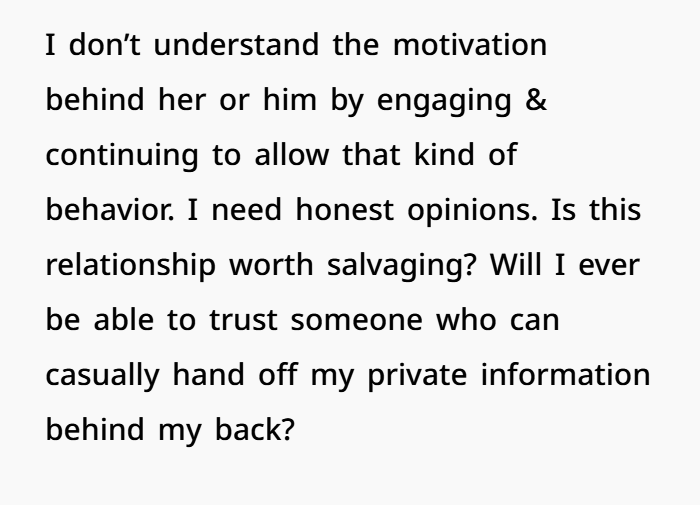
It is difficult to know exactly why the mother-in-law wanted this information.
Maybe she was worried.
Maybe she had concerns about money.
Maybe she was too involved in her adult son’s relationship.
There could be several explanations.
Trying to diagnose her behavior from a few messages is not useful.
The behavior itself matters more.
Another adult’s pregnancy, medication, bank information, debts, and personal finances are sensitive matters.
Being related to someone does not automatically give a person access to that information.
Financial Boundaries Matter in Relationships
Money is an important subject for couples.
Partners may discuss household expenses, credit card debt, savings, insurance coverage, mortgages, investments, and long-term financial planning.
Those conversations require trust.
A couple should be able to decide together what financial information stays private and what can be discussed with relatives.
This can become even more important after having a baby.
Families may be thinking about health insurance, life insurance, emergency savings, retirement planning, housing costs, childcare expenses, and other long-term financial decisions.
Those are important conversations.
But private financial planning does not automatically need to include extended family members.
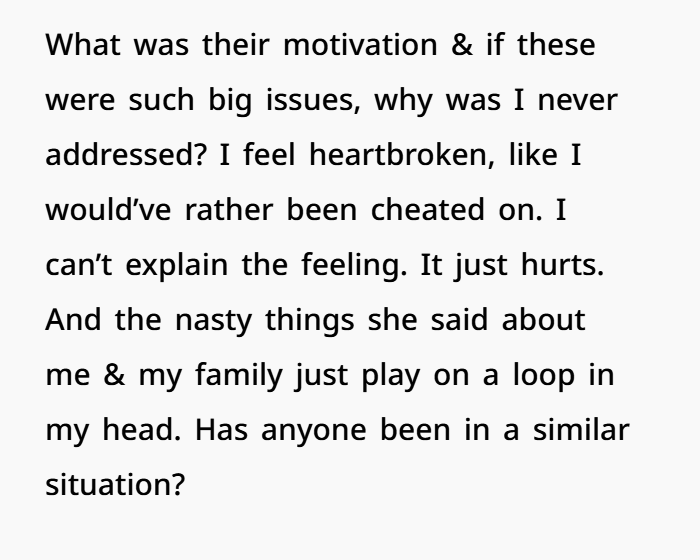
The Betrayal May Feel Very Personal
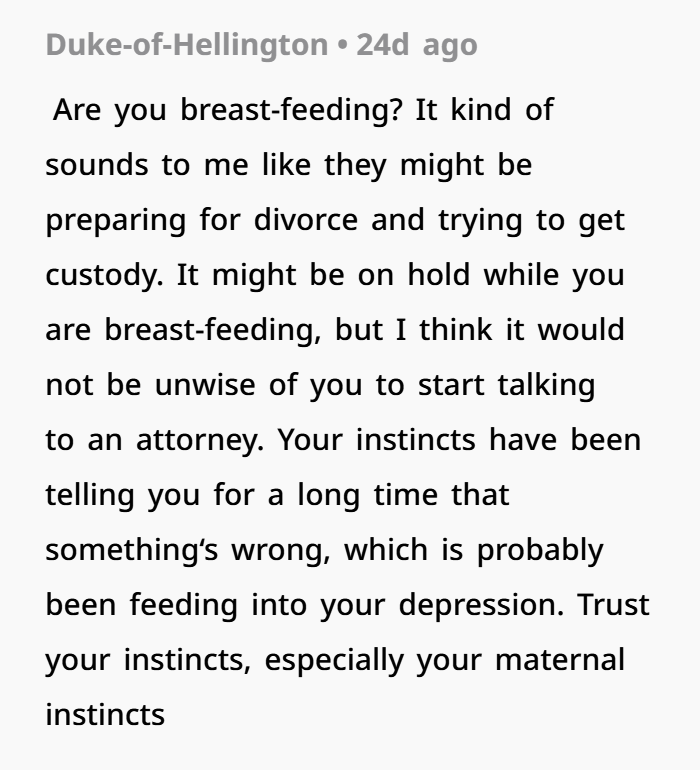
The woman reportedly feels that this situation is as painful as, or even more painful than, infidelity.
Her reaction may make more sense when looking at what she believes happened.
The problem is not simply that her mother-in-law said negative things about her.
She believed she and her partner were working together privately as they prepared to become parents.
Then she discovered that personal details about their life were apparently being discussed with someone else without her knowledge.
That can deeply damage trust.
Rebuilding Trust Also Means Rebuilding Privacy
If this couple wants to stay together, they may need to rebuild the privacy around their relationship.
Her medical information should not be shared without her permission.
Sensitive banking information should be protected.
Private discussions about debt, medication, pregnancy, health care, and household finances should respect her boundaries.
Her partner may also need to show through his actions that those boundaries will continue.
That could mean being more transparent, setting firm limits with his mother, and participating seriously in couples therapy.
Trust may be possible to rebuild.
But promises alone may not be enough.
What matters most is what happens next.
If her partner respects her privacy and changes his behavior, the relationship may have a path forward.
If private information continues to be shared without her knowledge, then this is no longer only a past mistake.
The underlying problem is still there.
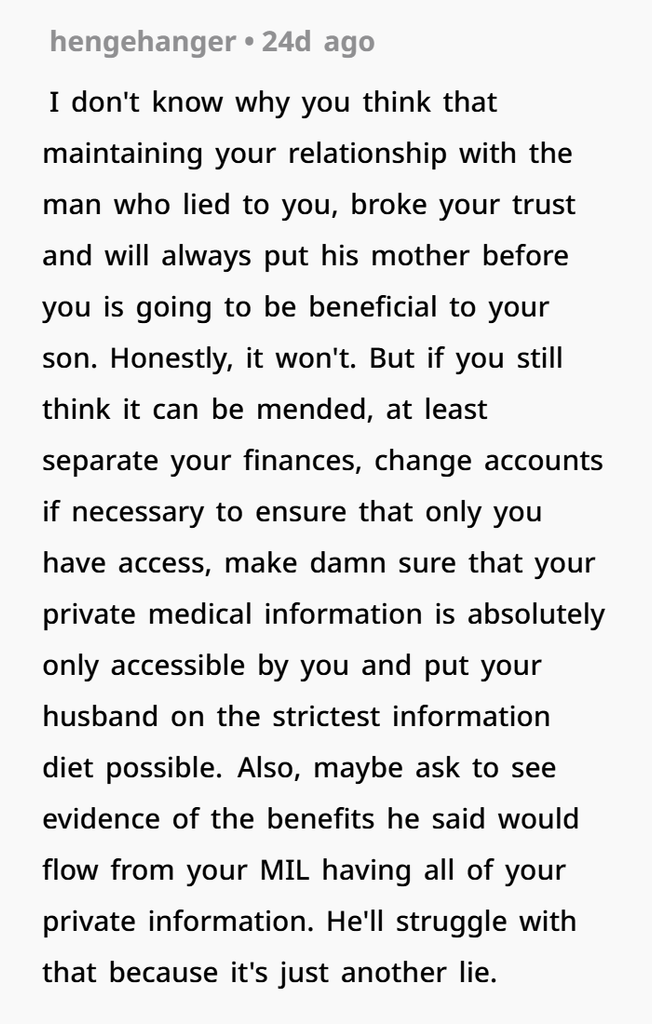
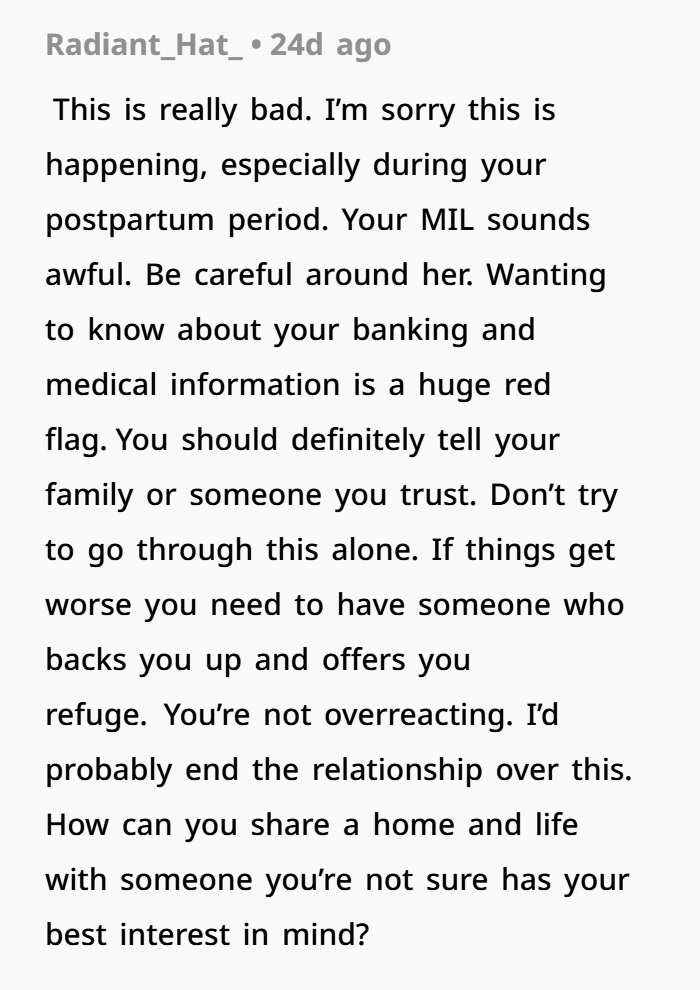
Readers’ Comments Speak Out