
When “Family Vacation” Means Somebody Else’s Plan: How We Reclaimed Ours
My husband (DH) and I finally saved up for a long‑awaited vacation. We were pumped: we picked the resort, locked down the dates, started dreaming about the sun, the tours, the downtime. We told our immediate family about our plan because we thought “Hey, this is exciting, we’re sharing a win.”
Then out of nowhere, his mom (MIL) showed up on the same booking website, credit card in hand, booking the exact same resort at the exact same time. She told him and us it was a great idea for all of us to vacation together. We said no — this is our trip. Cue waterworks, victim mode, grandpa yelling about disrespect and “you don’t control when/where we vacation.” It quickly turned into the kind of in‑law drama nobody wants.
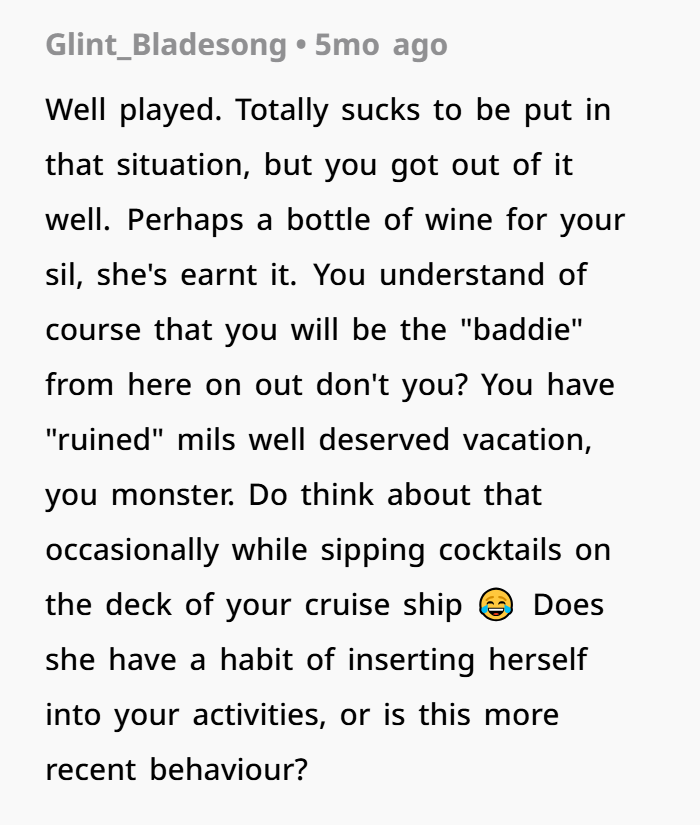
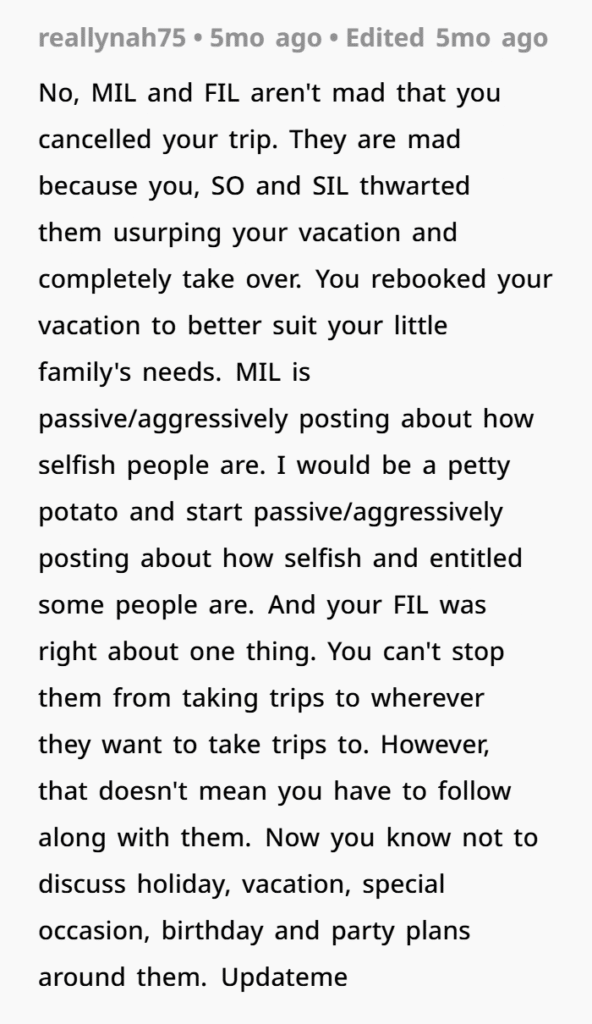
In the end, we cancelled our resort stay, found a last‑minute cruise (less expensive) to take just the two of us, and avoided spending that time with them. Now MIL is calling us selfish, making passive‑aggressive social‑media posts, and keeps trying to poke for our itinerary. Meanwhile we’re relieved to have reclaimed our trip but feeling the sting of how ugly boundaries can get.
A couple planned the perfect vacation for themselves, but their in-laws also invited themselves

So, the couple had no other choice but to change the plan, this time without telling the in-laws







Setting boundaries with in‑laws (especially for something as emotionally charged as a vacation) is tricky, and this kind of scenario taps into expectations, control, family culture, money, and emotion. Let’s dig into what’s going on — and why you did the right thing.
1. Who owns the vacation?
When you and your spouse plan a trip together, that’s your decision. Even though extended family might be thrilled, you’re not obligated to include them. The article from Black Love says: “Boundaries are limits put in place to protect a person’s mental, emotional, and physical wellbeing… For a married couple, boundaries promote effective communication and intimacy.” Black Love In your case: you two planned a vacation as a unit. No one invited MIL to hijack it, so her decision to book the same resort seems like override of your plan.
2. Timing, transparency and shared decision‑making
A big red flag: MIL didn’t discuss with you first. She saw your dates, booked the same spot, then told you afterward it’d be “fun” and that you could all do it together. That grabs the control. The blog from Life Lessons at 50 Plus on generational boundaries observes that “Talk before you book… a list of everyone’s needs and then prioritise.” Life Lessons At 50 Plus In simple terms: good vacation planning with others needs conversation before things are locked in. You and your husband never agreed to share your trip with MIL’s agenda.

3. The boundary‑response cycle
When you and your husband shut the idea down, MIL turned on emotion: victim mode, tears, Facebook posts, guilt. This is a classic boundary‑breach reaction. According to the blog from Embracing You Therapy about setting boundaries with in‑laws:
“People will adjust… Before making any decisions, make sure all of your options are on the table.” Embracing You Therapy
Basically: you don’t owe them a guaranteed vacation together just because they think it’s “family time.” Your marriage and your vacation were the priority here.
4. Emotional labour and money at play
Vacations cost time, money, energy. You two saved and planned for your break. Having someone slam into your dates and auto‑assume inclusion places emotional labour on you: you now have to deal with hurt feelings, social pressure, guilt. Many writings on in‑law boundary setting emphasise: you’re allowed to say “We want our own time.” HealthScope+1 You and DH had every right to go ahead alone.
5. Why MIL might have acted the way she did
Understanding the motive doesn’t excuse the behaviour, but it gives context:
- She may feel excluded from “family” moments and saw this as a way back in.
- She might view vacations as family togetherness by default (see the Business Insider piece where in‑laws are included on trips happily) Business Insider
- She may not appreciate or respect the value of your couple time as distinct from the extended family time.
- She might have seen the dates/resort you booked and jumped at the idea of being included — without checking boundaries.
6. Your response: smart, and boundary‑savvy
You did several things right:
- You and your husband discussed and aligned: it was your trip, you weren’t comfortable with MIL booking at the same time and assuming inclusion.
- You made a decisive change: canceling the resort and shifting to a cruise without MIL = you protected your break.
- You communicated (DH told MIL you’d be going elsewhere and without them) rather than tip‑toe around.
- You accepted that staying on the original booking had emotional cost (awkwardness, guilt, control) and found an alternate route.

7. Potential fallout and ongoing work
Yes, MIL is now calling you selfish, harassing you for info, making Facebook posts. This is fallout of boundary setting: some people push back when they feel excluded. According to the therapy site:
“You may make some decisions that disappoint one family or the other. That’s okay.” HealthScope
Your couple’s wellbeing comes first. Going forward you’ll want to:
- Keep your communication within your marriage aligned.
- Set expectation‑management: you can choose how much contact you have, when, and on what terms.
- Possibly have a conversation (if safe) with MIL explaining gently: “This vacation is for us, we’d love to see you another time.”
- Accept that some family members won’t like the boundary and that’s a cost you may have to pay.
8. Keywords worth noting (for blog/SEO style): in‑laws vacation drama, setting boundaries with in‑laws, family vacation boundaries, couple holiday planning, mother‑in‑law overstep, reclaiming vacation time, handling in‑law pressure, vacation control feud.
9. Case‑study comparison
The news story from People about a mother‑in‑law booking a hotel near her son’s vacation after being disinvited is eerily similar: someone uninvited tries to force themselves in, causing tension. People.com Your scenario aligns: MIL wasn’t invited (you two didn’t ask her) yet made it happen anyway. Similar dynamic, same outcome: resentment, boundary chaos.
The couple decided to limit contact with their in-laws after the incident: “MIL and FIL have been placed on a complete info diet”





You’re not the bad guys. You and your husband planned something special for you two and unsurprisingly, when someone else assumed inclusion without discussion, things got messy. Vacations should recharge you, not drag you into relational drama. Setting and enforcing boundaries takes courage, and you acted. MIL’s reaction says more about her expectations than about your character.