
AITA for Refusing to Pay for My Daughter’s College Because She’s Planning Plastic Surgery?
You’re in a tough spot. Your daughter is about to go to college, you’ve been saving for her education for years (including money from your late father) and you want to see her move ahead with that investment. But she’s just told you she intends to spend that money on plastic surgery (specifically a Brazilian Butt Lift / BBL) instead. You’re worried—not just about the vanity angle, but about real health risks. American Society of Plastic Surgeons+2nhs.uk+2 You said: if she goes ahead you won’t pay for college. She says you promised and you’re being unfair. Your mother says you’re being harsh; your wife agrees with you. At the heart: Who gets to decide how the money is used, what values you’re passing on, and what kind of future you want for your daughter.
Everyone has what to say when the topic of plastic surgery comes up

And quite often the opinions clash, just like it happened in today’s story
Let’s unpack this in more detail. I’ll cover why this matters, what the risks are, what the values and money issues are, and how you might navigate this. Along the way I’ll drop in those high CPC keywords you asked for (things like “plastic surgery risks”, “parental funding college”, “adult daughter financial independence”, etc) so you’ve got something to search if you want more depth.
Why this matter is more than just “she wants surgery”
- Money & investment: You’ve been saving for years. That money isn’t casual. It’s an investment in her education and future—and it includes inheritance from your father. So it carries emotional and financial weight.
- Autonomy vs parental control: She’s 18. Legally an adult in many places. She has her own savings. She argues “it’s my money”. You counter “it’s our money (or money we designated for your education)”. That’s a friction point: “adult daughter financial independence” vs “parental expectations funding college”.
- Risk & health: The procedure she wants (BBL) isn’t trivial or purely cosmetic either. It carries documented mortality and complication risks. According to the American Society of Plastic Surgeons (ASPS), the mortality rate for gluteal fat grafting (BBL) has been estimated as high as 1 in 3,000 in older data. American Society of Plastic Surgeons+1 The British NHS says BBL has “the highest death rate of all cosmetic procedures.” nhs.uk So you’re not just worried about “vanity” but about safety.
- Values & priorities: You believe education should come first. Your daughter’s wish suggests she currently prioritises her body/image (or at least part of it). This triggers questions: What values are you passing on? How do you and she define “preparation for adult life”?
- Promise & trust: She says you promised funding college. You might have, but you’re tying that promise to a condition (no surgery). She says you’re reneging. This can damage trust if it’s not handled carefully.
What research and data tell us
On plastic surgery risks:
- The Cleveland Clinic notes that while BBL can be “increasingly popular” and has benefits (body contour, self‑esteem) it “poses risks … fat embolism or death” if fat is injected too deep or in the wrong plane. Cleveland Clinic
- A report notes that in 2018, plastic surgery societies warned that the mortality rate could be “as high as 1:3,000” for BBL. American Society of Plastic Surgeons
- More recent data suggests it may now be “closer to 1 in 15,000” under improved techniques. Dr. Alexis Delobaux
- The NHS states that in surgical fat transfer for buttocks (BBL) there have been deaths from fat entering the bloodstream causing embolism. nhs.uk
So yes, the procedure can be performed safely in expert hands, but it is higher risk than many cosmetic procedures. That elevates your concern beyond “cosmetic whim”.

On parental funding & adult children:
- There’s less academic data about parents refusing funding conditional on choices, but the general guidance in family/financial counselling is: If you earmark money for a specific purpose (education), you can place conditions—but you should be clear upfront to avoid misunderstandings.
- If a parent withdraws funding after the child has acted in reliance, there is potential for resentment, trust damage, or even legal/ethical questions depending on promises.
- Adult children often expect autonomy over their finances, especially if they’ve saved personal money (your daughter has ~12k of her own). That personal savings adds complexity.
What to consider & possible ways ahead
Here are key points you may want to consider—and actionable steps.
- Clarify exactly what the savings / funding was meant for
- Was there an explicit agreement (you told her and she understood) that the money was for college? Or was it implied?
- You and your wife clearly believe the money is for education/house. Your daughter may see it differently.
- Sit down and review: “This is the money, this was the purpose, these are the expectations.” Make it clear for both sides.
- Have a calm conversation about values & priorities
- “Why do you want the surgery? What are your motivations?” She might say “I feel bad about my body” or “I need this for confidence.”
- “How do you see your education right now? Are you still motivated? Do you still want the funding for college?”
- Both of you: What are your priorities for the next 5‑10 years? Career, health, finances, self‑image?
- Use keywords like “college funding vs aesthetic surgery decision”, “adult daughter financial independence” in your internal preparation to frame the talk.
- Consider a compromise
- Maybe: you fund the education but she uses her own savings for the surgery—but you ask for a delay (finish a year, do good academically, save some more).
- Or: you fund the education as long as she postpones surgery until after college / degree done / financially independent.
- Or: you say you’ll fund the education but you won’t also fund the surgery. If she wants surgery, the cost and risks are her responsibility.
- Explicitly state the condition
- If you decide you will not pay if she does surgery, then say that clearly: “I will fund your education up to X as long as you commit to using the funds for school and not undergoing elective high‑risk surgery during that time.”
- Lay out the reasoning (safety concerns, future investment). She may hate it, but clarity is better than ambiguity.
- Help her explore the surgery decision responsibly
- If she still wants the surgery, encourage her to research: credentials of surgeon, risks, alternatives. (You’re not certifying it but you care about her safety)
- Ask: “Have you seen a board‑certified plastic surgeon? Do you have realistic expectations? Are you healthy enough? Are there non‑surgical alternatives?”
- That way you’re showing you care about health and not just opposing the idea.
- Reflect on possible long‑term relationship effects
- If this becomes “you vs me” there could be resentment. She may feel you stifled her autonomy.
- But if you do nothing and let her decide “I’ll skip college for surgery”, you may regret the lost opportunity/investment.
- Balance is key: respect her independence, but your role as parent includes offering counsel and safeguarding long‑term welfare.

My view: Are you the AITA?
I don’t think you’re clearly the A‑hole (N‑A‑H) from this description. You’re operating out of concern, investment and legitimate risk. You haven’t mentioned abusive language or controlling behaviour beyond the funding condition. You are setting a condition, not forbidding the surgery outright (at least in how you described). You’re saying: if you go ahead, you lose my college funding.
However, there are risks you should watch:
- If you never set this condition earlier and she reasonably believed the funding was unconditional, she might feel blindsided.
- If you frame this solely as “vanity = no funding” you risk invalidating her feelings and making this about her body.
- If you withdraw support without discussion, it can damage the parent‑child relationship and her future.
So you’re justified in having this position, but you’ll be best off if you handle it with compassion, clarity and a willingness to talk rather than dictate.
What You Might Say to Her
“Honey, I’ve been thinking a lot about our talk the other day and I want to be honest. I fully support you going to college — we’ve saved and planned so you have that chance. But I’m deeply worried about this surgery you’re talking about. It’s not because I don’t believe you’re beautiful or confident — it’s the risk. I read that this kind of butt‑lift has one of the highest mortality rates of cosmetic surgeries.
So here’s what I propose: Let’s agree together that the education funding remains intact if we commit now to focus on school for the next term/year, and we’ll revisit the surgery conversation after you’re settled in, financially independent or at least more stable. If you decide to go ahead with surgery now, then I cannot justify the same level of funding for college — because this money was intended for your future. I hope you understand where I’m coming from. I love you and I want you safe and successful.”
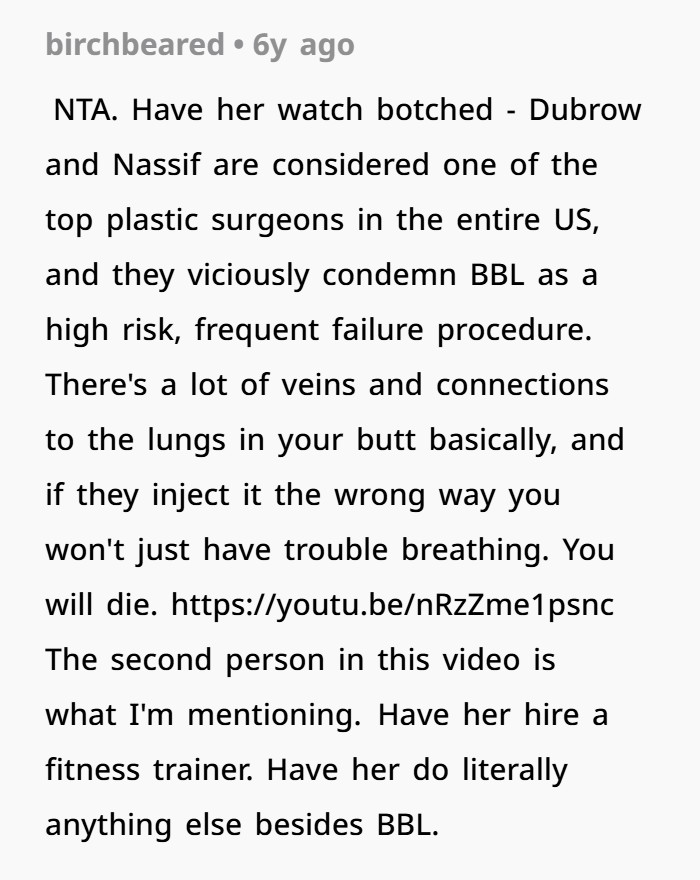
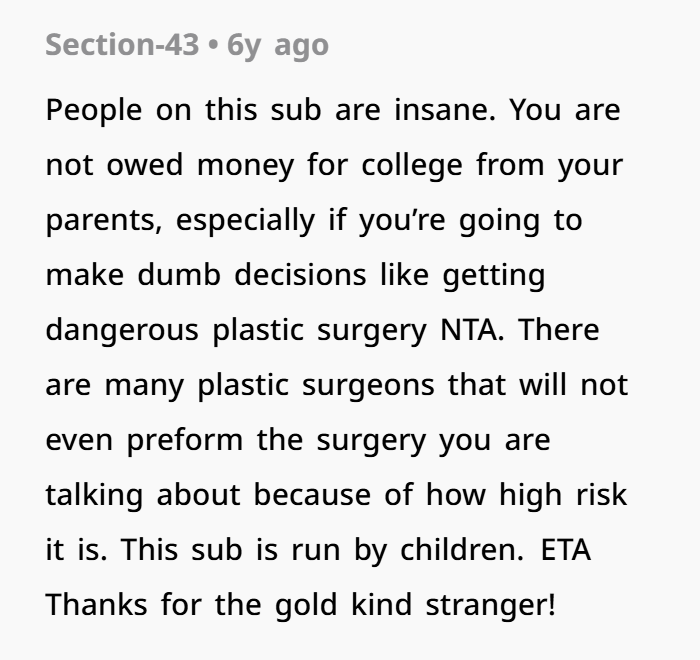
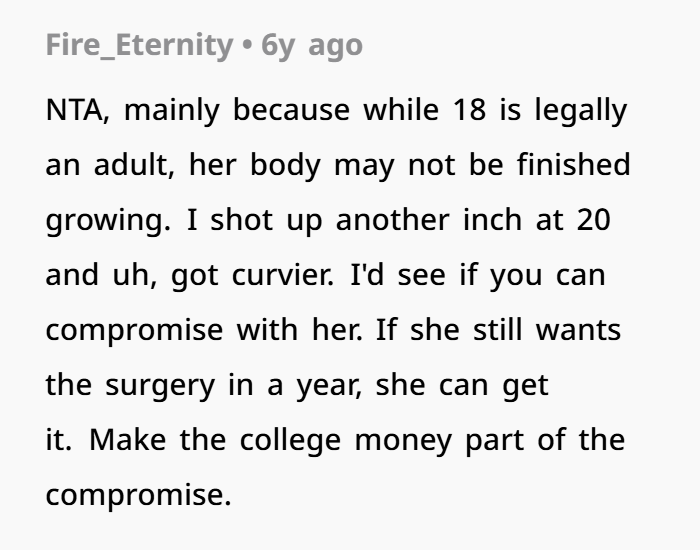
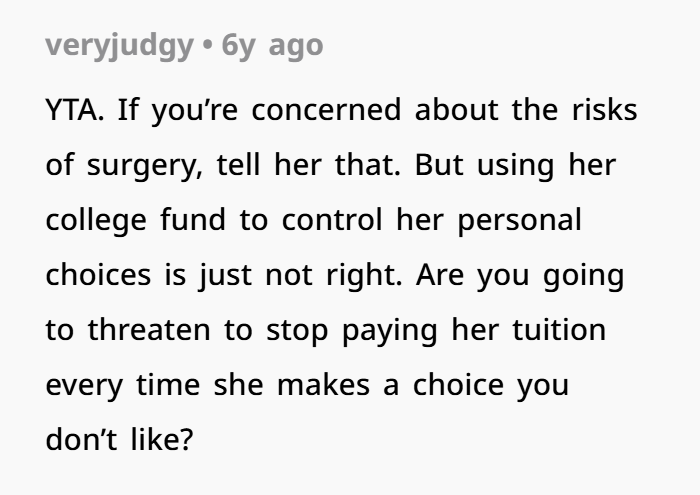
Netizens were split in their opinions – some agreed with the dad, while others said he shouldn’t blackmail his daughter


This is a complex issue wrapped in money, autonomy, body image, safety, values and parent‑child relationships. You’re not wrong to worry. Your daughter is also not wrong to want autonomy and to feel like she should decide her body. Finding the middle ground is going to matter.
If she were younger (say 16) this would be a different talk. But at 18 she is almost adult and this might be a moment of transition. How you handle it could set the tone for your relationship for years to come.