Father Confronts His Wife After Their 17-Year-Old Son Reveals Why He Doesn’t Want to Date Anyone

A father shared his family problem on Reddit after having a serious argument with his wife. The disagreement started when their 17-year-old son told his father something personal. Soon, it turned into a bigger problem about parenting, family relationships, and trust.
Their son, called Austin in the story, was doing well in school. He also had a part-time job and helped with chores at home. But his mother wasn’t happy that he spent most of his free time playing video games with friends instead of dating girls.
She had been asking him to find a girlfriend for years. She also worried that she might never have grandchildren if he continued to avoid dating.
Things became more serious when Austin told his father that he was asexual and aromantic. He also explained that he was afraid to tell his mother because he didn’t know how she would react.
When his father shared the news with his wife, she became upset and questioned whether their son really understood his feelings. The father finally confronted her, saying her constant criticism was exactly why Austin didn’t open up to her. Now, with his wife refusing to speak much to him, the father is wondering whether he went too far by calling out her behavior.













A Hardworking Teenager Who Preferred Video Games Over Dating
The 39-year-old father began his Reddit post by explaining that he and his 38-year-old wife have one child, a 17-year-old son he called Austin.
By his father’s account, Austin was the kind of teenager many parents would be proud of.
He earned straight A’s while taking Advanced Placement (AP) classes. He also worked part-time, finished his household chores, and sometimes helped with extra tasks without being asked.
There was one thing Austin especially enjoyed doing in his free time: playing online multiplayer games with his friends.
His father had no problem with that. Austin was keeping up with school, work, and his responsibilities at home. As far as his dad was concerned, he deserved to spend his free time doing something he loved.
His mother saw things differently.
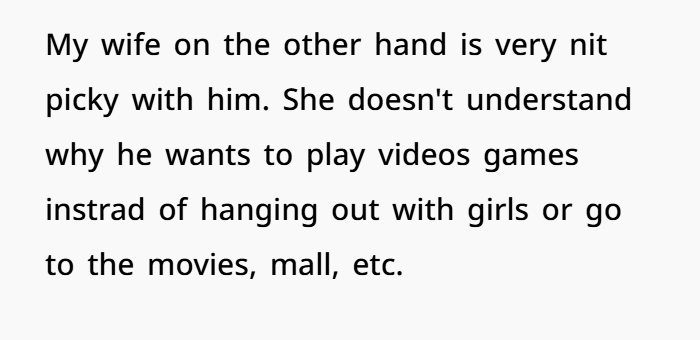
She couldn’t understand why a 17-year-old boy would rather play video games than go to the movies, visit the mall, or spend time with girls.
Austin had already explained that dating simply didn’t interest him. He knew college was coming soon, and he wasn’t worried about finding a girlfriend before then.
But his answer never seemed to satisfy his mother.
His Mother’s Worries About Grandchildren Became a Constant Problem
According to the father, his wife had spent years questioning Austin’s lack of interest in romantic relationships.
In private conversations, she repeatedly told her husband that she hoped their son wasn’t gay.
The father found these comments especially frustrating because he described their family as progressive.
His wife also had another concern. Austin was their only child, and she had always wanted grandchildren.
The father reminded her several times that gay couples could become parents through adoption. Still, she continued worrying about their son’s future.
Her concerns eventually turned into attempts to find Austin a girlfriend.
She even offered to introduce him to the daughters of her friends and coworkers.
Austin wasn’t interested, and his father could tell the attention was making him uncomfortable.
What his mother seemed to view as encouragement was becoming a source of pressure for her son.
This kind of tension can make parent-teen communication difficult. The American Academy of Pediatrics advises parents to listen without judgment, especially when teenagers discuss personal matters.
When young people expect criticism every time they share something, they may become less willing to open up.
And in Austin’s case, that appeared to be exactly what was happening.
Austin Finally Told His Father Something He Had Been Keeping Private
A few days before the family argument, Austin approached his father with something important to say.
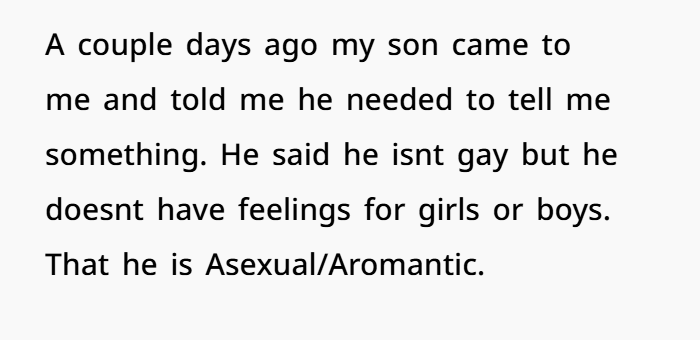
He explained that he wasn’t gay. But he also didn’t experience romantic or sexual attraction toward girls or boys.
Austin identified himself as asexual and aromantic.
His father didn’t react with shock or disappointment. Instead, he reassured Austin that nothing had changed between them.
He loved his son and wanted him to feel happy and comfortable with who he was.
That response seemed to give Austin the support he needed.
But there was still one difficult conversation ahead.
Austin wanted his mother to know, too. Unfortunately, he didn’t feel comfortable telling her himself.
He was worried about what she might say and didn’t want to deal with another upsetting conversation.
So he asked his father to share the news for him.
His father agreed.
That detail later became important because the father made it clear that he wasn’t revealing his son’s private information without permission. Austin had specifically asked him to tell his mother.
What Does Being Asexual and Aromantic Mean?
Austin’s confession was about more than simply not wanting a girlfriend at 17.
According to The Trevor Project’s guide to asexuality, asexual people generally experience little or no sexual attraction. Aromantic people experience little or no romantic attraction.
The two identities are different, although someone can identify as both.
Being asexual doesn’t mean someone cannot form close relationships or care deeply about others. Asexual people can have meaningful friendships, partnerships, and family relationships.
The same is true for aromantic people, who may value strong friendships and other close connections without wanting a traditional romantic relationship.
It also doesn’t automatically mean someone will never marry or have children.
The Trevor Project explains that attraction, relationships, and personal choices are not the same thing. People’s experiences can vary.
For Austin, the point was simple. He was sharing how he understood his feelings at that time.
He wasn’t asking his parents to make decisions about his future. He wanted them to understand him.
His Mother’s Reaction Was Exactly What Austin Had Feared
The father waited until Austin was at work before speaking privately with his wife.
He told her that their son identified as asexual and aromantic.
Instead of asking how Austin was feeling, she became angry.
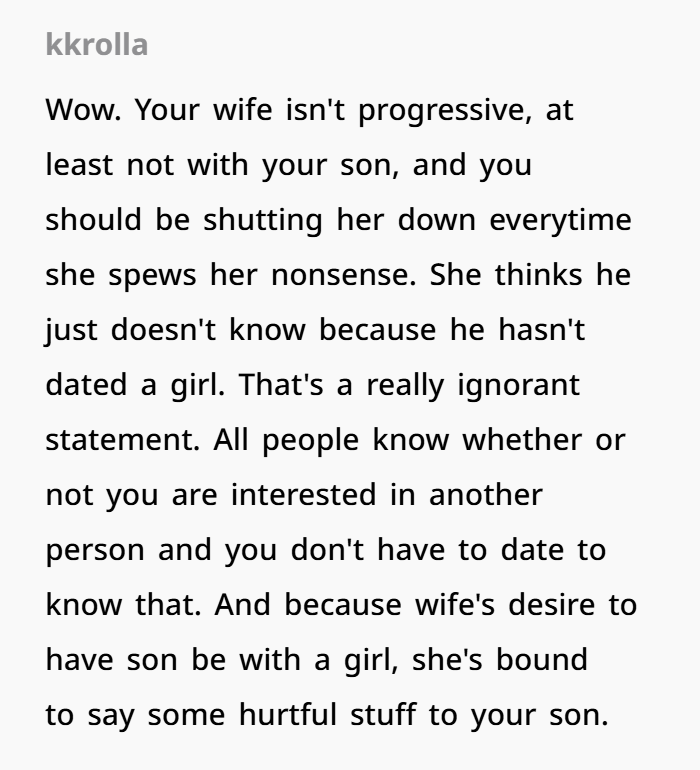
She insisted that he was confused and questioned how he could know anything about his sexuality when he had never dated a girl.
She also announced that she planned to speak with Austin herself.
Then she brought up something that upset her even more.
She was hurt that Austin had told his father instead of coming directly to her.
That was the moment her husband lost his patience.
For years, he had watched his wife criticize their son’s interests and push him toward dating. Now, after hearing something deeply personal about Austin, she was focusing on her own disappointment.
To the father, her reaction explained exactly why Austin had been afraid to tell her.
The Father Finally Confronted His Wife About Her Behavior
The father didn’t try to soften his message.
He told his wife that the reason Austin kept things from her was because she constantly complained and judged him.
He reminded her that she had spent years pressuring their son to find a partner without considering what Austin actually wanted.
He also accused her of making the situation about her own happiness instead of their son’s feelings.
In his view, she wasn’t trying to understand Austin. She was trying to control an important part of his personal life.
The father then made his position clear.
He didn’t want his wife confronting Austin or trying to convince him that he simply hadn’t given romantic relationships a chance.
If she attempted to pressure their son again, he warned that he would be very upset.
His words were harsh, but the frustration behind them had been building for years.
The argument wasn’t just about Austin’s sexuality anymore. It was about trust, respect, and the way his mother had been treating him.
His Wife Accused Him of Spoiling Their Son
The confrontation didn’t end peacefully.
His wife became furious and called him an “asshole.”
She accused him of coddling Austin instead of encouraging him to grow up.
Then she returned to the subject that had worried her for years.
She said they would never have grandchildren.
For the father, that response only made the situation more upsetting.
He had just explained that their son needed acceptance and understanding. Yet his wife was still talking about the future she had imagined for herself.
After the argument, things remained tense at home.
The mother barely spoke to Austin when he returned from work. She also gave her husband the cold shoulder.
The father was left wondering if he had gone too far by confronting her so directly.
Still, he didn’t regret wanting to protect his son.
He explained that Austin’s sexuality, or lack of sexual attraction, didn’t change how he felt about him.
His biggest concern was making sure his son felt loved and supported.
Why Family Support Matters for Teenagers Exploring Their Identity
Austin’s story raises a question many families face: What happens when a teenager’s personal choices don’t match their parents’ expectations?
Parents may have hopes about their children’s future relationships, careers, marriage, or family life.
But those hopes can become difficult for teenagers when they start feeling like requirements.
Research suggests that family acceptance plays a meaningful role in the well-being of LGBTQ+ young people.
A 2024 study published in JAMA Pediatrics examined data from more than 60,000 adolescents receiving primary care. Researchers found that parental support helped protect LGBTQ+ teenagers against some negative mental health outcomes.
The study did not examine Austin’s family, and it cannot tell us how this particular disagreement will affect him. Still, it shows why supportive parenting deserves attention.
The Family Acceptance Project at San Francisco State University has also studied how family reactions to young people’s identities relate to their health and well-being.
Its research has found that accepting and rejecting family behaviors can make a difference in young people’s lives.
For Austin, having a father who listened without questioning his identity appeared to make it easier for him to share something personal.
His relationship with his mother was more complicated.
Why Austin Felt Safer Talking to His Father
One of the most telling parts of the story was Austin’s decision to ask his father to speak for him.
He wasn’t trying to hide the truth from his mother forever.
He wanted her to know, but he didn’t want to face her reaction alone.
That difference matters.
The American Academy of Pediatrics’ advice on talking with teenagers encourages parents to show interest in their children’s lives, respect their feelings, and avoid turning difficult conversations into lectures.
It also recommends taking responsibility when parents make mistakes.
Austin’s mother may have believed she was helping him by encouraging dating. But according to the father’s account, those repeated conversations had left Austin uncomfortable.
By the time he had something deeply personal to share, he already expected criticism.
His father had built a different kind of relationship with him.
He allowed Austin to enjoy his hobbies, trusted him to handle his responsibilities, and accepted his explanation without demanding proof.
That doesn’t mean the father was perfect or that every word he used during the argument was helpful.
But it helps explain why Austin chose to approach him first.
The Grandchildren Argument Revealed a Bigger Family Conflict
Another painful part of the story was the mother’s repeated focus on having grandchildren.
She had imagined a future where Austin would find a partner and eventually have children.
When Austin shared that he didn’t experience romantic or sexual attraction, she seemed to view it as the loss of that future.
But being asexual or aromantic doesn’t automatically decide whether someone will become a parent.
More importantly, Austin was only 17.
He was still in high school, preparing for college, working part-time, and enjoying time with his friends.
There was no immediate reason for him to make decisions about marriage or children.
His father’s frustration came from watching those adult expectations placed on a teenager who had already said he wasn’t interested in dating.
The mother’s disappointment may have been real. But the father believed it was unfair to make Austin responsible for fulfilling her hopes.
Was the Father Wrong for Speaking So Harshly?
The father’s decision to confront his wife came after years of watching her pressure their son.
From his perspective, staying quiet would have allowed the same behavior to continue.
He wanted to make it clear that Austin shouldn’t have to defend his identity or prove that his feelings were real.
At the same time, the conversation became heated.
Calling out someone’s behavior can be necessary, but anger can also make it harder for that person to listen.
The American Academy of Pediatrics recommends respectful communication even during disagreements. That includes avoiding blame and hurtful language when possible.
Still, the father’s central concern was understandable.
Austin had trusted him with private information and had asked him to share it. His mother responded in the very way Austin had feared.
The father wasn’t asking his wife to understand everything immediately.
He wanted her to stop pressuring their son and give him room to be himself.
The Father Clarified One Important Detail After Sharing His Story
After posting his experience, the father added an edit to clear up a possible misunderstanding.
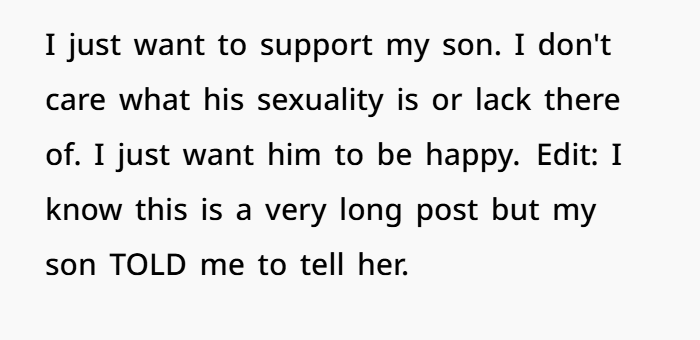
He emphasized that Austin had directly asked him to tell his mother about his identity.
He had not gone behind his son’s back or shared the information without permission.
That clarification mattered because coming out can be a deeply personal experience, and people may want to choose when and how others learn about their identity.
The father later added another short message.
He said he had an update about the situation but couldn’t post it for a few days because his attempts were being removed.
He planned to share the update on Wednesday.
However, the original account provided here doesn’t include that follow-up, so it’s unclear what happened next.
For now, the story ends with a family still struggling to communicate.
A father wants his son to feel accepted. A mother is upset about the future she expected. And a 17-year-old boy is caught between two very different reactions to something personal.
The biggest question isn’t whether Austin will eventually date, marry, or have children.
It’s whether his mother can learn to listen to him without making him feel judged.
Because the more comfortable Austin feels being himself at home, the more likely he may be to share his life with the people who love him.
See the comments to know what people said
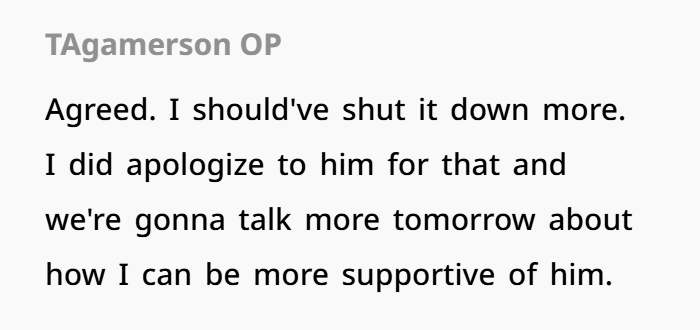


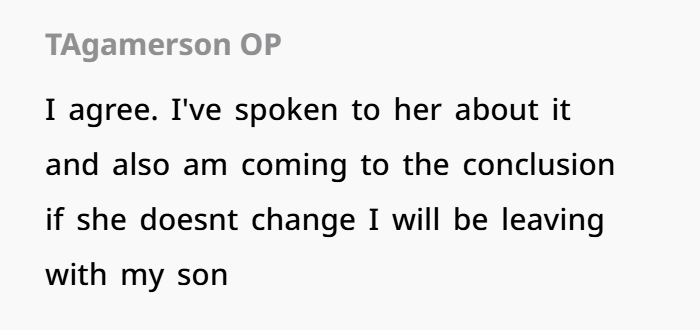
At the heart of this story is a 17-year-old boy who simply wants to be accepted for who he is. Austin works hard, does well in school, helps at home, and enjoys spending time with his friends. Yet his mother’s constant pressure to start dating has made it difficult for him to open up to her.
His father may have spoken harshly during their argument, but his main concern was protecting his son’s happiness. He wanted his wife to understand that Austin’s future should be about his own choices, not her dreams of becoming a grandmother.
The situation also shows how much parental support, healthy family relationships, and open communication matter during the teenage years. Children are more likely to share personal feelings when they know they won’t be judged or criticized.
For now, it’s unclear whether Austin’s mother will change her approach. But one thing stands out: his father wants him to know that he doesn’t need to change who he is to earn his family’s love.